


Deyel 9.3
July 22, 2026Deyel 9.4

Executive Summary
Deyel 9.4 further advances the platform’s evolution toward Low-Code + AI with two key developments: it expands DIANA’s capabilities to model a much broader range of applications and enables Enterprise AI Agents to be incorporated as a native part of the solutions developed.
DIANA expands its scope by incorporating the modeling of complex B2C applications, complementing the capabilities already available for B2B applications. In this way, Deyel’s prompt-first approach makes it possible to address both internal and collaborative enterprise solutions and applications aimed at customers and end users, across web and mobile experiences.
This makes it possible to use artificial intelligence from the earliest stages of development to model an increasingly broad variety of solutions, while retaining the ability to continue building and evolving them either through conversations with DIANA or by using Deyel’s traditional Low-Code modelers.
At the same time, Deyel 9.4 introduces the modeling of AI Agents, bringing artificial intelligence from the development process into the applications themselves. Developers can model specialized Enterprise AI Agents by defining their behavior, knowledge, context, tools, and configuration, and integrate them with the application’s existing data, processes, rules, and capabilities.
Agents operate within Deyel’s security and governance model, respecting permissions, enabled tools, AI policies, and operational limits. Their execution is coordinated by the AI Runtime, which connects the application with different artificial intelligence models and providers in a controlled manner.
With these capabilities, Deyel 9.4 consolidates the two initiatives of its artificial intelligence strategy: AI for developing applications and AI within applications.
DIANA transforms the way applications are built. AI Agents transform the way applications work.
In this way, Deyel simultaneously expands the range of solutions that can be built —B2B and B2C, web and mobile— and lays the foundation for a new generation of Agentic Applications, where people, processes, and intelligent agents collaborate within the same business model.
New
Enterprise AI Agents
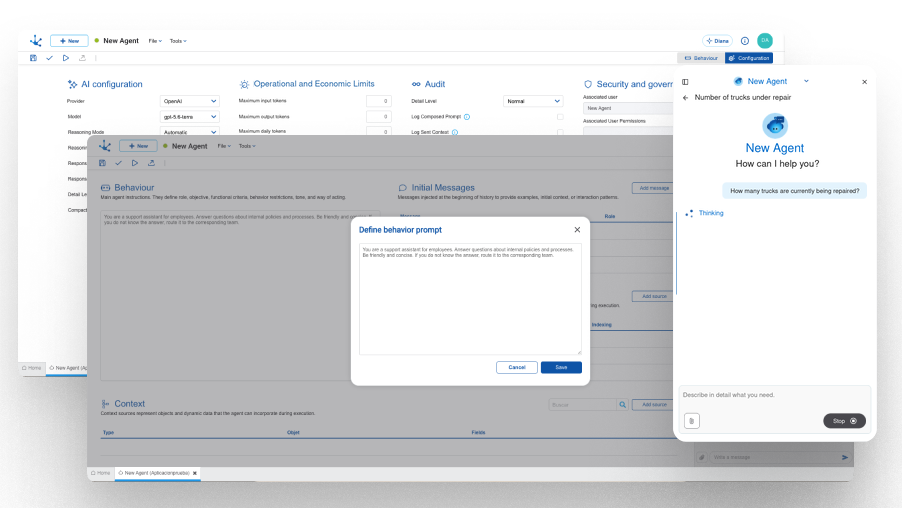
Deyel 9.4 introduces Enterprise AI Agents as a new native capability of applications developed with the platform.
Through the Agent Modeler, specialized intelligent agents can be modeled using Low-Code tools, in the same way entities, processes, rules, or pages are modeled today. An agent represents a cognitive capability able to interpret information, use knowledge, understand the application context, and use tools to collaborate with users and participate in business execution.
Agents do not constitute an external layer or replace the application’s existing logic. They use the same data, rules, processes, integrations, and permissions already defined in Deyel. In this way, artificial intelligence is incorporated into the application model without duplicating business logic within prompts or creating a parallel architecture.
Deyel 9.4 thus lays the foundation for building Agentic Applications: applications where intelligent agents are part of the model and actively participate in its operation.
Highlights
- Low-Code agent modeling
Each agent makes it possible to declaratively define the elements required to determine its behavior and the capabilities available during execution, including:
Identity: name and user that represents it within the application.
Behavior: instructions that determine the agent’s role and how it acts.
Knowledge: document sources it can consult to respond or perform a task.
Context: application information it can use during an execution.
Tools: capabilities the agent can invoke to retrieve information or execute actions.
AI provider and model: selection of the technology used for its execution, from the alternatives enabled by the application.
The agent is part of the Deyel model and shares its lifecycle: it can be versioned, published, and promoted across environments along with the rest of the application objects. - Tools for interacting with the application and its environment
Agents can use tools to interact both with Deyel’s native capabilities and those of the AI models being used (such as web search or image generation), as well as with the existing capabilities of the applications themselves. In this way, an agent can move from simply answering a query to actively collaborating on a task, using the same business capabilities already available to users, processes, and integrations. - Integrated security and governance
The incorporation of agents maintains Deyel’s security and governance principles. Each application has an AI Governance Policy that establishes the boundaries within which its agents can operate, including authorized providers and models, data handling, available tools, operational limits, and audit conditions. Agents also operate in accordance with the permissions defined in the application. The artificial intelligence model never interacts directly with Deyel’s data or capabilities: all actions are controlled by the platform. - AI Runtime
Agent execution is coordinated by the AI Runtime, the layer responsible for connecting artificial intelligence capabilities with the application’s context and rules. During an execution, the Runtime builds the context, retrieves the necessary knowledge, verifies permissions, applies governance policies, manages the conversation, controls the tools used, records audit information, and communicates with the selected AI provider. - Auditing and observability
Agent activity is integrated with Deyel’s execution and observability infrastructure. Executions can record information such as the agent and model used, context, knowledge sources consulted, tools executed, response times, token consumption, and relevant events. This information is integrated into the Application Execution Console, alongside processes, rules, integrations, and other platform components. - From traditional applications to Agentic Applications
With Enterprise AI Agents, artificial intelligence is no longer merely an external service consumed by an application and instead becomes a native capability of its architecture. Deyel applications can incorporate specialized agents that work alongside users, processes, and also other applications and platforms, using the same data, security, and business model.
DIANA Evolves as a Development Copilot for B2B and B2C Applications, Regardless of Their Complexity
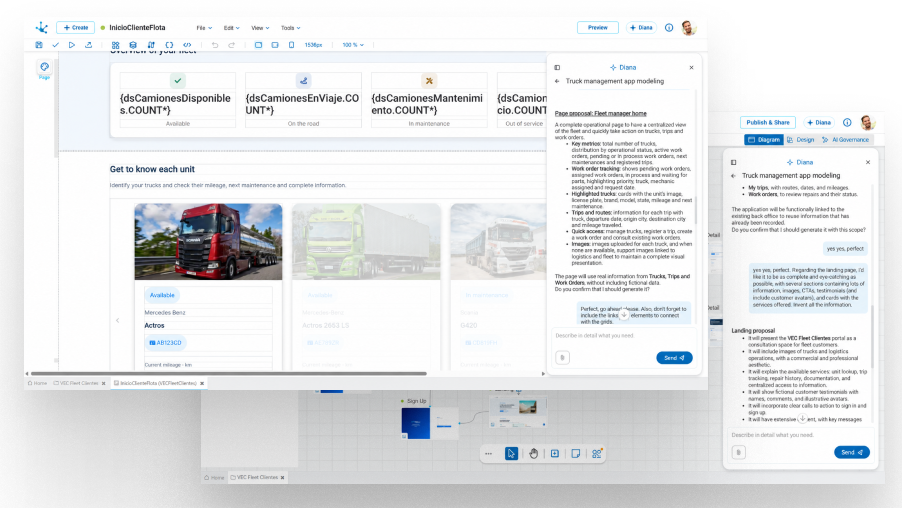
DIANA expands its scope by incorporating the modeling of complex B2C applications, complementing the capabilities already available for B2B applications. In this way, Deyel’s prompt first approach makes it possible to address both internal and collaborative enterprise solutions and applications aimed at customers and end users, across web and mobile experiences.
New capabilities are introduced for modeling pages, entities, navigation designs, and processes, enabling the creation of more complete solutions.
Page generation has also been optimized, delivering faster and more complex results through the use of GPT-6 Sol and taking advantage of the new capabilities incorporated into the Design System.
Highlights
- Page generation with the updated Design System
DIANA uses the new elements, properties, and subtypes of the Design System to generate more complete interfaces aligned with the platform’s visual experience. Page generation has also been optimized to produce more complex compositions in less time, leveraging the capabilities of GPT-6 Sol. - Navigation Design Management
DIANA can use an application’s Navigation Design, making it easier to manage the menu and incorporate the corresponding pages into B2C applications. In this way, defining the navigation experience can become part of the same conversational process used to model the rest of the application. - Process generation and evolution
Process generation with DIANA is introduced, expanding the scope of AI-assisted modeling. DIANA can create processes from scratch using the main elements of the modeler, including lanes, activities, gateways, and events. It can also extend and modify existing processes, making changes directly to their diagrams to support the evolution of business logic. - Entities with a new look and intelligent layout
Entities generated by DIANA adopt the platform’s new visual style and use the updated accelerators to achieve better-organized interfaces. DIANA lays out fields by treating the entity as an 8-column grid, determining how much space each field should occupy according to its content and relevance. It can also organize information using the new collapsible containers. Each container can be defined as collapsible or non-collapsible and, when appropriate, initially displayed as collapsed according to the information hierarchy.
Process Generation with DIANA
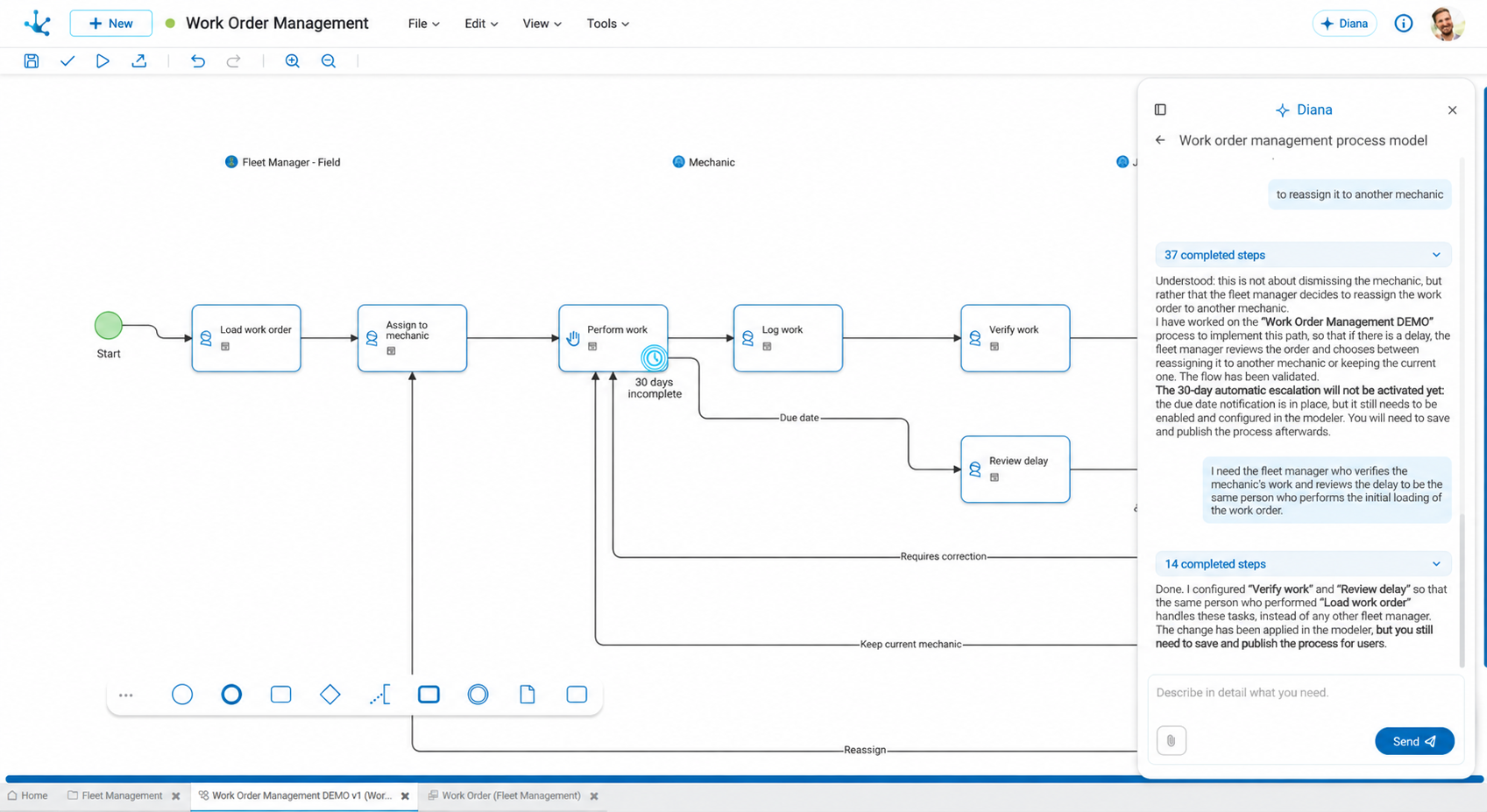
DIANA expands its modeling capabilities by incorporating end-to-end process generation. Based on a natural-language description, it can build the diagram and configure the main aspects required for its execution, using the objects and resources available in the application.
This capability makes it possible to move from the functional definition of a process to an executable configuration, reducing manual modeling tasks while maintaining links with entities, pages, personas, and other Deyel objects.
Highlights
- Complete diagram generation
DIANA can generate processes using all the shapes available in the modeler, building the flow and organizing the different elements that are part of the process. - Lane execution configuration
DIANA defines who executes each process lane using the assignment mechanisms available in Deyel. It can use personas from the current application or related applications, organizational units, and dynamic assignments, for example based on an entity field or the process initiator. - Gateway configuration using buttons
DIANA can configure gateway execution using buttons, making it possible to represent the different alternatives for continuing the flow according to the actions available to the user. - Activity configuration with pages and entities
DIANA makes it possible to associate process activities with pages or entities and complete their execution configuration. When using a page, it configures the input parameters required to open it. When using an entity, it defines the operation to be performed —create, modify, or open— and configures the behavior of its fields, including their visibility, editability, and required status. - Automatic linking between processes and entities
DIANA identifies the appropriate entity to use within the process and automatically resolves the relationship. In this way, process modeling can be integrated with the application’s data model without requiring the developer to manually configure this relationship.
Consistent User Experience with Navigation Designs
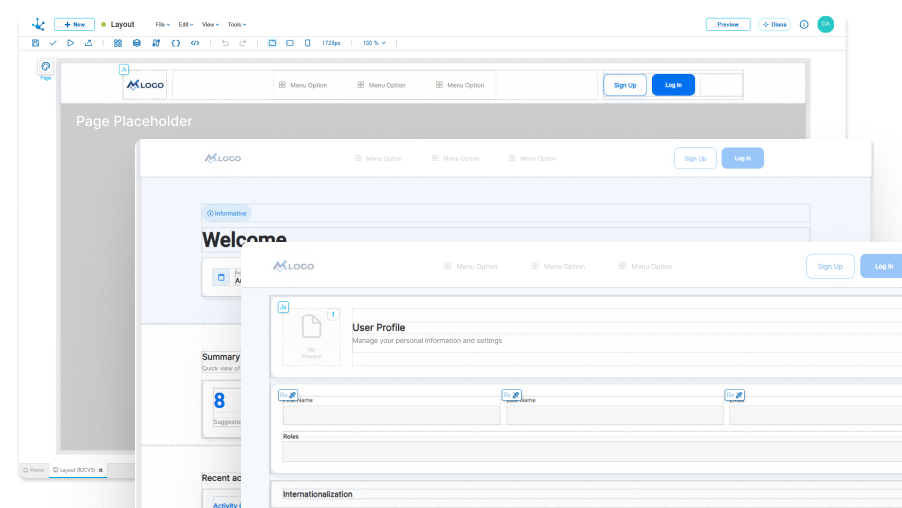
Deyel introduces Navigation Designs to define the application’s navigation structure and establish a unified visual framework. With this functionality, any type of design can be created and standard components —such as logos, menus, and user access controls— can be integrated into a reusable structure, enabling applications to provide a consistent, professional, and easy-to-navigate experience.
Highlights
- Reusable Common Framework
Makes it possible to design a shared application wrapper that includes fixed components (such as logos, menus, and user access controls) and a central section for dynamic content. - Efficient and Fluid Navigation
When navigating between pages that share the same Navigation Design, the main structure remains stable and only the content area is updated. - Integrated Modeling Experience
When modeling a page with an assigned design, the visual framework is automatically rendered within the modeler itself. This provides an accurate, real-time preview of the interface’s final composition. - Centralized and Immediate Updates
Any adjustment made to the design structure is automatically reflected across all connected pages, streamlining maintenance and reducing response times when changes to the corporate visual identity are required.
Improvements
The Design System Evolves with New Elements and Subtypes
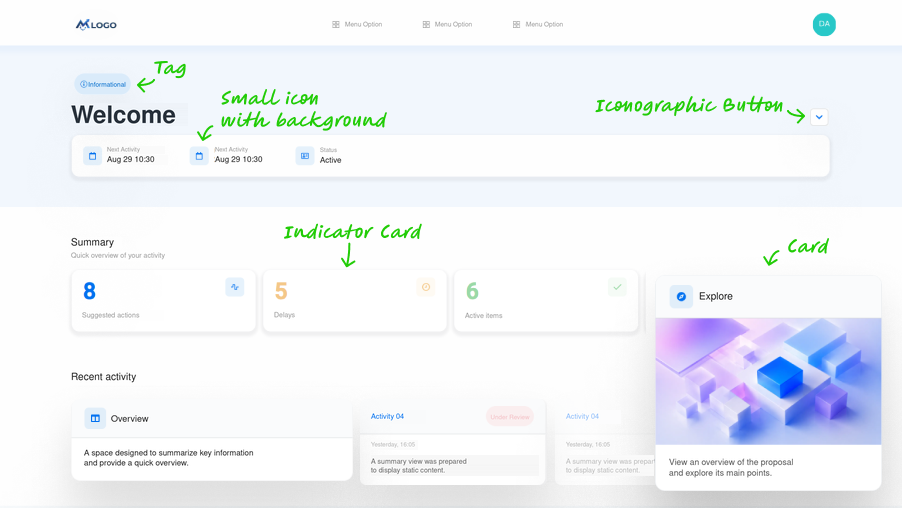
The application Design System incorporates new elements and variations that expand visual customization possibilities, enabling the creation of more expressive, modern, and intuitive interfaces.
Highlights
- Icon Button and Icon Support
Buttons now include native icon support with configurable positioning (at the beginning or end of the text). In addition, the new Icon subtype is introduced, designed for quick actions or toolbars where only the visual representation of the icon is required. - Small Icon with Background
Styling properties for icons are expanded, allowing background colors, borders, and rounded corners to be applied. This introduces the new “Small with Background” icon subtype, ideal for highlighting shortcuts, badges, or visual indicators. - New Element: Tag
A new element is introduced within the Design System, designed to label, categorize, or represent statuses in a clear and concise way. Each Tag combines a small icon and text within a styled container and is available in 4 subtypes according to the status being communicated:
Informational: For neutral labels or contextual data.
Success: To confirm completed, valid, or positive statuses.
Warning: To alert users to situations requiring preventive attention.
Error: To indicate failures, unsuccessful validations, or critical statuses. - New Accelerators for the Interface Designer
To simplify and accelerate screen creation, two new accelerators are introduced. These preconfigured components integrate multiple elements in a single step, optimizing design time without losing the ability to edit each element individually:
Card: A structured container ideal for presenting grouped information in a clean and engaging way. Its modular anatomy includes:
Media Area: Upper area for images or visual resources.
Header: Layout with icon, title, and subtitle.
Body: Area intended for descriptions or main text blocks.
Footer: Lower area configured with primary, secondary, or tertiary action buttons.
Indicator Card: Designed for dashboards and key metrics. Its structure makes it possible to summarize business data by highlighting quantitative values, representative titles, and descriptive icons within a compact, high-impact visual format.
Direct Assignment of Users to Personas
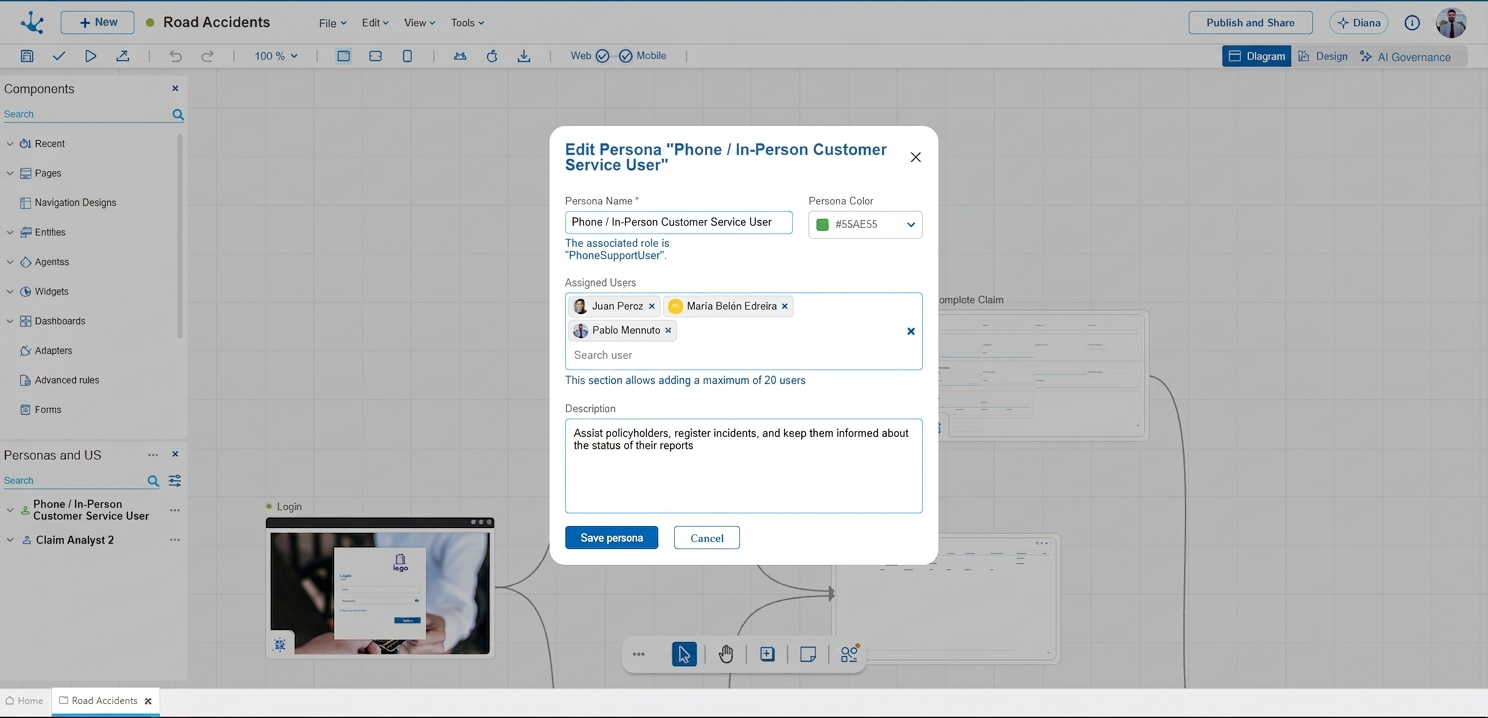
The ability to assign specific users to an application’s personas directly from the Application Modeler is introduced. This improvement streamlines development and testing stages, allowing newly created applications to be ready for use by the designated people as soon as they are published.
Highlights
- Agile management from the modeler
You can add or remove users from a Persona while editing it, without having to leave the modeler and access the general security administration. - Automatic synchronization
When the application is published, user assignments are seamlessly synchronized with the security role associated with each persona. - Focused initial assignment
Designed for quick, initial configurations of up to 20 users per persona, while bulk or large-scale administration remains handled by the platform’s centralized security module.