



Agentic AI in Procurement: Autonomous Agents Reshape Supplier Management
November 6, 2026
Compras y proveedores a prueba de futuro: Customizar y extender sin riesgos
November 6, 2026End-to-End Supplier Management: Risk and the Procure-to-Pay Cycle

Ensuring operational stability and protecting a company's working capital requires overcoming the historical disconnect between compliance controls and day-to-day purchasing. Third-party risk assessments and the execution of the Procure-to-Pay (P2P) cycle often operate in separate silos, creating critical blind spots for the business.
If a supplier's legal, tax, or financial validation is not automatically connected to the procurement process, the organization is exposed to supply disruptions, regulatory contingencies, and administrative friction.
Why address this integration today?
In the following sections, we will examine how to structure a sustainable assessment matrix, how to connect it to the daily procurement flow without adding bureaucracy, and how adaptive automation can protect the organization without slowing down the pace of procurement.

Multidimensional Assessment: Supplier Qualification and Risk Mitigation
Evaluating a supplier requires going beyond the commercial analysis of cost and delivery time. A robust architecture structures prequalification and ongoing monitoring across three critical dimensions:
- Financial Assessment: Analysis of financial statements, liquidity ratios, debt capacity, and customer concentration to anticipate insolvency risks before entering into long-term agreements.
- IT and Cybersecurity Assessment: Audit of regulatory and industry standards (ISO 27001, SOC 2), access controls, and business continuity plans (BCP) to prevent vulnerabilities across the digital chain of custody.
- ESG and Sustainability Assessment: Verification of environmental practices, waste management, and compliance with due diligence and social responsibility standards.
Methodological Criterion: To optimize resources, the depth of the assessment should be scaled according to the impact matrix of the input or service. While strategic or critical suppliers require a comprehensive audit across all three dimensions, non-critical categories can operate under simplified self-declaration models and automated tax validation.
According to McKinsey estimates, unplanned supply chain disruptions represent cumulative costs equivalent to 45% of one year's profits over the course of a decade for organizations that lack deep visibility into supplier risk.
The Connection to the P2P Cycle: From Need to Liquidity
The outcome of the assessment becomes meaningful when it shapes and accelerates daily operations across the P2P cycle:
Purchase Requisition (PR) and Warehouse Integration
The request initiated by the user area is classified as either goods or services. The system validates available inventory before authorizing external spending, routing to Procurement only those quantities that are unavailable or intangible service requirements.
Commercial Agreements (Framework Agreements) and Tenders (RFQ)
If the requirement matches an active Framework Agreement, the Purchase Order is generated immediately, deducting the corresponding amount from the agreed allocation. For requirements without a prior agreement, competitive bidding processes (RFQ) are configured with closing rules, real-time comparison tables, and transparent awarding.
Purchase Order (PO) Issuance and Receipt of Goods/Services
Approved requests are consolidated into official Purchase Orders under authorization matrices scaled by amount. After delivery, the acceptance record, whether full or partial, authorizes warehouse entry or certification of the service provided.
Tax Reconciliation, Invoicing, and Treasury
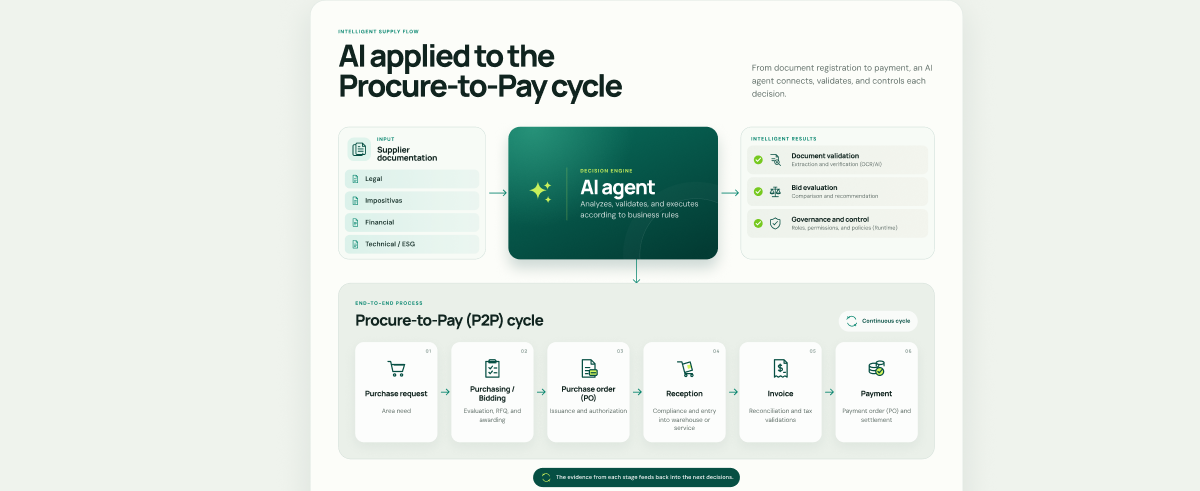
The process concludes with the reconciliation of supporting documents. The system applies tax validations according to geographic location, such as XML/CFDI files or invoice reading, routes credit notes when commercial discrepancies arise, and enables Payment Orders for final settlement.
Gartner studies indicate that more than 60% of security incidents and operational friction in midsize and large organizations originate from vulnerabilities or insufficient validation across supplier and contractor networks.
Agentic Capability: Governed Autonomous Execution Across the Process
To keep operations aligned with industry standards, modern management incorporates Agentic AI at critical points throughout the workflow.
Unlike traditional conversational tools, an agent acts as a native component of the system: it interprets objectives, analyzes documentation, queries sources, applies business rules, and autonomously executes specific actions within strict governance boundaries:
- Intelligent Analysis and Extraction: Analyzes documentation attached during onboarding or invoice submission using computer vision and AI models (OCR), automatically extracting validity dates, tax identifiers, and amounts to validate the consistency of the case file.
- Bid Evaluation in Tenders: In competitive bidding processes, the agent interprets received quotations, compares pricing, lead times, and commercial terms, selects the best option according to configured rules, and prepares the award and PO for notification.
- Governance and Operational Control: The agent does not operate with complete freedom; it performs its tasks within a controlled environment that verifies permissions, roles, and corporate security policies at every interaction (Runtime).
Modular and Intelligent Architecture: Toward an Adaptive Model
Unifying supplier assessment with the transactional efficiency of P2P requires a flexible infrastructure that seamlessly connects all participants in the ecosystem: requesters, buyers, technical evaluators, treasury teams, and suppliers themselves.
Under this approach, technology should not impose rigid structures or lengthy software projects. A highly functional model is built around an 80/20 core: a prebuilt foundation that addresses standard industry dynamics while remaining open to each company's identity and specific business rules.
- 80% preconfigured scope: The platform natively addresses common market requirements, including onboarding, document matrices, the complete P2P cycle, tax validations, and ERP synchronization.
- 20% agile customization: Precise adjustment of forms, amount-based approval matrices, criticality rules, and specific workflows through intuitive visual configuration, avoiding traditional development from scratch.
A Flexible and Modular Approach to Supplier Management
This adaptive vision is embodied in Deyel Vendor Management, a solution designed to simplify the operational complexity of Procurement through three key pillars:
- Evolutionary Flexibility: Organizations have the freedom to adapt and expand business rules, fields, and interactions as their processes mature or their needs change, without being locked into inflexible structures.
- Phased Implementation: Enables organizations to address Procurement priorities progressively. If the immediate need is managing document expirations and tax risk, the organization can begin with that module and later incorporate tender management, contracts, or technical assessments. In this way, adoption follows the pace of the business while optimizing investment.
- Governance and Agentic Efficiency: The incorporation of autonomous capabilities (Vendor Agent) to assist with analytical and repetitive tasks while maintaining a controlled, secure, and fully traceable environment.
Synchronizing risk mitigation with transactional agility helps organizations evolve from reactive administration toward a predictable, governable, and scalable procurement model. Deyel Vendor Management supports this transformation by bringing Assessment and P2P together within a single digital ecosystem.
