



Lovable vs. Deyel: From Vibe Coding to Enterprise Applications
November 6, 2026Low-Code and AI: Build Applications That Integrate People, Systems, and AI
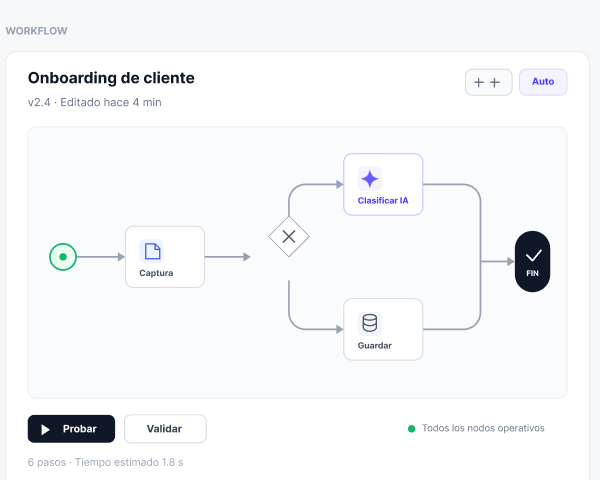
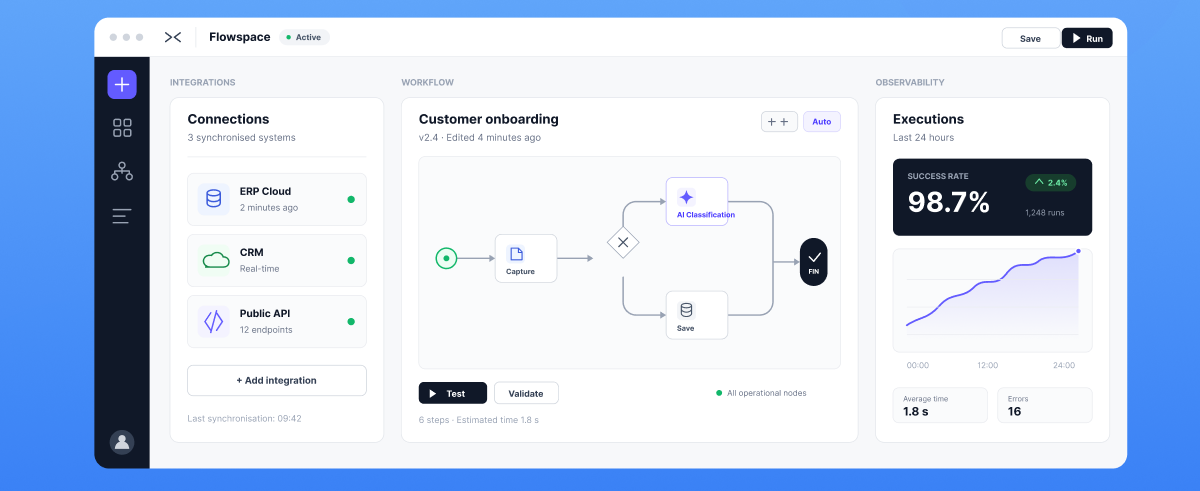
AI-assisted Low-Code development enables organizations to build enterprise applications that coordinate processes, connect existing systems, and enable intelligent agents, all within a strict framework of security and governance.
Many organizations today face an operational paradox: they have more software, automation, and AI models than ever before, yet their processes remain fragmented.
To scale with confidence, companies must evolve from isolated development toward an integrated application development model that brings together systems, people, and AI components.
The Anatomy of the Problem: Operational Fragmentation and Isolated AI
The rapid growth of tools across different departments often creates structural friction that affects business performance:
- Manual Handoffs and Fragile Integrations: Information becomes trapped in departmental silos, forcing teams to rely on manual data entry or rudimentary connections between applications that frequently fail.
- Isolated and Ungoverned Artificial Intelligence: AI models are deployed for specific tasks, but because they are not integrated into applications or core operational workflows, their insights do not translate into concrete actions.
- Temporary Patches and Technical Debt: Emergency solutions and disconnected automation workflows solve immediate problems but accumulate operational complexity that slows down future innovation efforts.
The Architecture of Coordinated Work: Four Strategic Pillars
To overcome technology fragmentation and build an agile operation, the strategy should be based on four execution pillars grounded in modern application development:
1. AI-Accelerated Application Development
Use AI to accelerate the design and development of enterprise applications, from the initial generation of screens, processes, business rules, and data models to their validation and evolution through Low-Code tools. This approach makes it possible to move from prompt to prototype in hours and advance toward production in weeks, maintaining technical control throughout the entire development lifecycle rather than limiting AI to simple code generation.
2. End-to-End Orchestration
Beyond simply creating technical connections between tools, organizations need to build applications that use a BPMN (Business Process Model and Notation) process engine to automate and coordinate real workflows across core systems, operational teams, and AI agents. Orchestration preserves long-term process traceability and ensures that, once a task is completed, the next step is automatically triggered in the appropriate interface or system, regardless of who or what performs it (a human or an AI agent).
3. Governance, Oversight, and Human-in-the-Loop
Implement centralized control frameworks to audit automated decisions and ensure regulatory compliance. Introducing AI agents does not mean delegating every decision autonomously: organizations must be able to define permissions, levels of autonomy, human approval points (Human-in-the-Loop), and real-time visual control panels while maintaining complete operational traceability.
4. Incremental Modernization (Without Replacing the Core)
Leverage existing infrastructure investments. Instead of undertaking disruptive projects to replace the core system, the priority is to develop enterprise application layers that connect existing architectures and build the capabilities the organization needs on top of them.
Impact Matrix by Operational Sector
Execution Roadmap
To carry out an effective transition without disrupting daily operations, it is recommended to follow three stages:
- Dependency Mapping: Identify the critical points where information flow is interrupted or where repetitive manual intervention is required between systems and departments.
- Low-Code and AI Development Platform: Adopt a platform for modeling screens, data, and processes with integrated AI Agents. This approach accelerates the transition from prototype to production in a mission-critical environment, ensuring coexistence with current systems without forcing their replacement.
- Establishing Governance Policies: Define permissions, levels of autonomy, development validations, and human oversight rules before delegating decisions to automated processes.
The Future of Operational Efficiency
An organization's performance depends largely on how seamlessly its systems, human teams, and artificial intelligence agents collaborate with one another. Unifying these assets in a coordinated environment under strict governance is the decisive step toward modernizing operations with security, speed, and control.
