


The CIO’s Dilemma in Insurance: How to Innovate When 80% of the Budget Goes to Maintaining Operations
September 3, 2026
4 Trends Redefining Insurance Operations Management
November 6, 2026From Months to Days: How to Launch Insurance Products Without Getting Trapped in Development Bureaucracy
Over the past decade, the insurance industry has invested considerable resources in studying new consumer behaviors. The diagnosis is clear: today’s policyholder does not want standardized policies with annual renewals; they are looking for usage-based coverage, insurance for urban mobility, dynamic protection for e-commerce, and the ability to resolve a claim from their phone in just a few clicks.
Commercial and product teams understand the demand and have the ideas needed to respond. However, in practice, launching a policy tailored to a new product or modifying a customer service workflow still takes between six and nine months.
One of the factors that most hinders innovation in insurance is development bureaucracy: the operational gap between what is designed in a strategic presentation and the actual ability to put it into operation for customers.
The Friction of the "Case-by-Case" Approach and the Cost of Moving Slowly
When an insurer promises a seamless digital experience but requires users to send emails with attachments to report a simple collision, that commercial promise breaks down at the very first real interaction. The same happens on the sales side: when an agent or intermediary tries to quote a non-standard risk and has to wait 48 hours because the system cannot configure that variable without manual intervention, the sale is often lost to a more agile competitor.
Historically, the response to these bottlenecks has always been the same: draft a functional requirements document, send it to the technology department, and wait for it to enter the priority queue. By the time the module is ready for testing, the market context or the customer’s needs have already changed.
This disconnect has a direct impact on business metrics:
- Lost premiums due to delayed Time-to-Market: Arriving late to a consumer trend or a distribution agreement (embedded insurance) means giving up market share.
- Customer churn caused by friction in claims: The moment of truth in insurance is the claim. If initial intake and validation depend on manual processes, dissatisfaction translates directly into non-renewals.
- Hidden rework costs: Operations staff end up spending hours manually reconciling data or entering information across multiple screens to compensate for what the system does not handle automatically.
According to a global Capgemini study on insurance trends, only one-third of insurers believe their current operational processes are agile enough to respond to changing customer expectations in real time”.
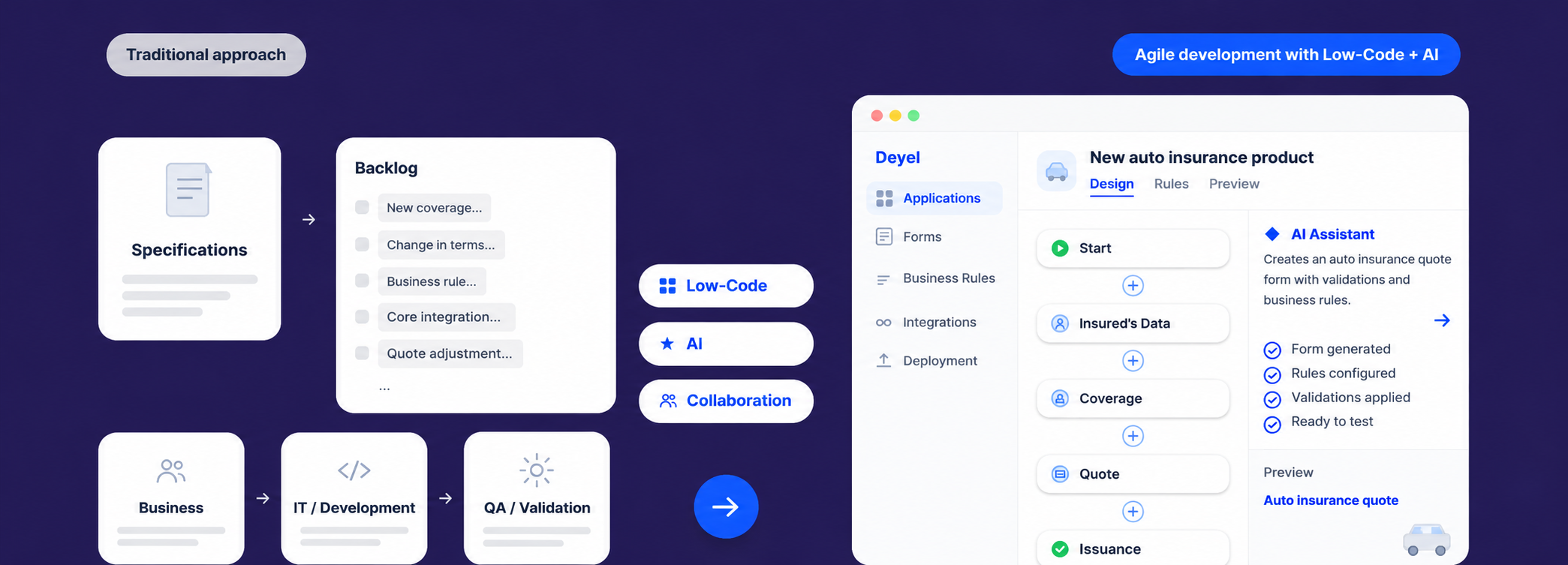
Comparative Analysis: Moving from Bureaucracy to Agile Development
To understand how timelines can be reduced from months to days, it is useful to compare the traditional development model with an approach based on flexible platforms:
(Development Bureaucracy)
(Low-Code + AI)
Design Applications Without Starting from Scratch
To break this inertia, operations teams must stop being mere "requirements writers" and become active participants in process modeling. If the team that understands risk and serves policyholders cannot adjust a validation rule or modify data capture without depending on weeks of coding, commercial agility is nothing more than a statement of intent.
The key to unlocking this dynamic is not replacing the company’s infrastructure, but adopting development platforms that provide the flexibility needed to build, adapt, and deploy business applications in a matter of days.
This is where platforms like Deyel provide differentiated value by combining Low-Code development with artificial intelligence (DIANA). A product or operations leader does not need to write code to bring a process to life; they only need to describe the required application in natural language for the AI Agent to generate a functional base structure.
From that point on, business and technology teams collaborate within the same environment: they visually adjust the interface, define business rules, and adapt fields to real operational needs. The result is optimized delivery times, ensuring that technology moves at the speed required by the business strategy.
