


From Months to Days: How to Launch Insurance Products Without Getting Trapped in Development Bureaucracy
November 6, 2026
Agentic AI in Procurement and Vendor Management
November 6, 20264 Trends Redefining Insurance Operations Management
After years of digitizing processes while accumulating isolated portals and rigid automation tools, companies across the insurance sector face a clear challenge: evolving toward flexible, integrated operations with controlled autonomy.
Analyses from several global firms agree that insurers' success will no longer depend on adding more data-entry screens, but on their ability to connect systems, orchestrate processes, and enable people and artificial intelligence to work across operations within a shared control framework.
We examine the four trends shaping the industry's strategic direction and how modern software architecture responds to this landscape.
Embedded Insurance: Selling at the point of need
Traditional distribution channels are shifting toward consumers’ everyday transactions. Travel policies, extended warranties, and damage protection are no longer purchased only at an insurance agent’s office; they are now seamlessly integrated into e-commerce platforms, financial apps, and mobility services.
Industry figures confirm this acceleration: an estimate published by The Business Research Company projects that the global embedded insurance market will reach $138.08 billion in 2026, driven by sustained annual growth of nearly 19%.
Making quotes, policy issuance, and payments available through third-party applications without modifying or overloading the insurer’s core systems.
Building web applications and services connected through APIs that communicate directly and securely with transactional systems, delivering responses in milliseconds without compromising business stability.
End-to-end orchestration: From fragmented processes to continuous workflows
One of the biggest bottlenecks in insurance management is still information scattered across systems. A single claim or underwriting process often involves emails, external assessments, spreadsheets, and approvals across multiple disconnected tools.
Reports from Bain & Company on industry efficiency emphasize that true operational value comes not from automating isolated tasks, but from redesigning and connecting the entire process from beginning to end.
Eliminating the manual transfer of files and data among policyholders, agents, assessors, and the finance team while preserving context and end-to-end traceability for every case.
Implementing business process management (BPM) engines and dynamic business rules. This makes it possible to determine the appropriate path for each case based on business rules, automatically assign tasks to the relevant roles, and monitor Service Level Agreements (SLAs) in real time within a single framework.
Controlled autonomy within the workflow: Intelligence in service of orchestration
Process orchestration reaches its full potential when combined with artificial intelligence’s analytical and problem-solving capabilities. In insurance, much of the critical information still arrives in unstructured formats: damage images, reports, forms, emails, and PDF documents. Without process context, interpreting that data solves only part of the problem.
Assessing complex claims quickly without relinquishing financial control or taking on regulatory risks.
Integrating agentic AI directly into the orchestration workflow. In a claims process, a cognitive agent can interpret documentation and context, retrieve available information from different systems, validate conditions against business rules, and carry out the actions authorized for that case. The process engine retains coordination and control rules: when exceptions, high-value amounts, or sensitive decisions arise, the case is automatically routed to a human specialist (Human-in-the-Loop).
Reducing time-to-market: AI-assisted development and agility without technology constraints
To meet these market demands in time, IT departments are under growing pressure to shorten development cycles without sacrificing security, integration, extensibility, or governance.
The industry is moving toward AI-assisted application development, where faster prototyping does not compromise future architecture or produce disposable code.
Prototyping and launching new policies or service workflows in days—not months—while retaining the ability to adapt the code as regulations or business needs change.
Adopting genuinely extensible Low-Code platforms (customizable & extensible). With a Prompt-First approach, technology teams can accelerate the initial stages by generating an application’s foundation in natural language. The most important evolution is not just creating prototypes quickly, but building them on a governed architecture that allows the same application to continue through development and deployment directly to production, while preserving the freedom to integrate custom code for complex business rules.
Key Trends Transforming the Insurance Industry
The Industry Challenge: Innovating with a Governed Architecture
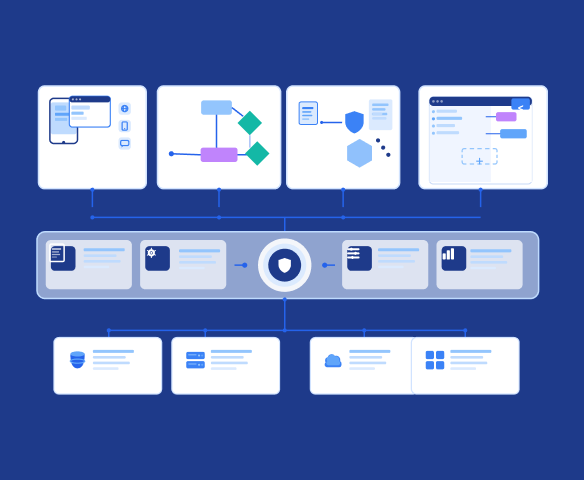
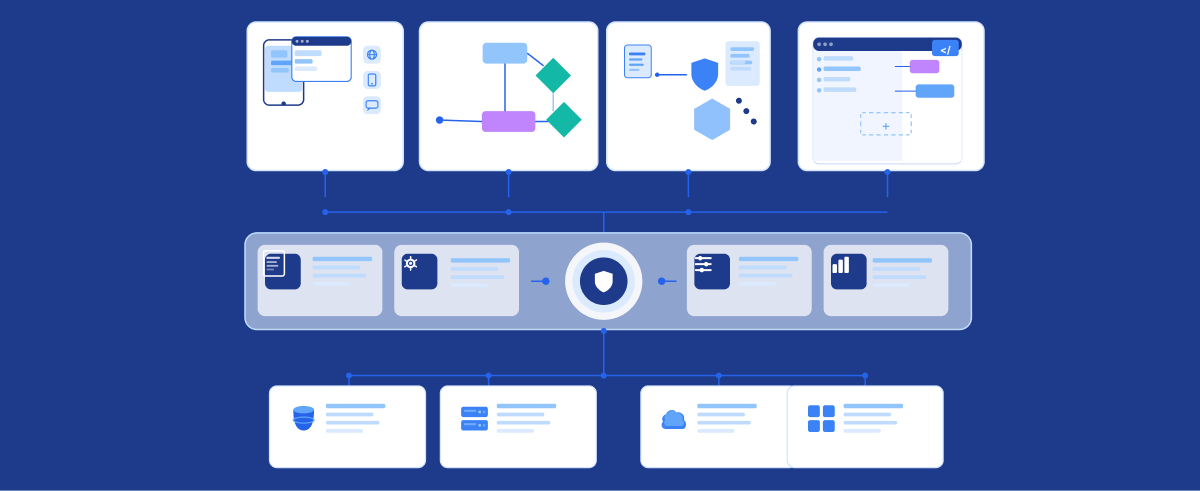
The next stage of insurance transformation is not about adding another AI tool, another portal, or an isolated automation. It is about building on an architecture that can connect Channels, Applications, Processes, Agents, and Core Systems under a shared governance model.
Organizations that build this operational agility on top of their core systems will not only respond faster to market demands, but also turn their technology infrastructure into a true engine for growth.
