


AI and Low-Code: The End of Repetitive Code in the Enterprise Backend
September 3, 2026The CIO’s Dilemma in Insurance: How to Innovate When 80% of the Budget Goes to Maintaining Operations
For technology teams in the insurance industry, the primary mandate has always been stability. Core systems, transactional platforms, and policy databases represent the operational backbone of the company. These architectures are designed to process massive volumes of data with high precision and comply with strict regulatory requirements, but not to adapt to weekly changes or iterate digital experiences in real time.
This reality places technology and architecture leaders in a complex position. On the one hand, executive leadership and business teams demand rapid integrations, self-service portals, and the adoption of artificial intelligence-based tools. On the other hand, the technical infrastructure requires caution, ongoing maintenance, and rigorous operational risk management.
The result is a recurring imbalance: most of IT's time and budget is consumed by maintaining the stability of existing systems, leaving very little room for the development of new capabilities.
The Real Cost of Shortcuts and the Problem of Large-Scale Replacement
Faced with the urgency of responding to business demands, the industry has explored different approaches, most of them with mixed results:
- The total replacement strategy (Big Bang): For years, the definitive solution was believed to be migrating the entire environment to a more modern insurance core system. In practice, these projects have proven to involve extremely long timelines, escalating costs, and a level of operational risk that few organizations can afford to take on.
- Custom development without a unified framework: Trying to address each requirement individually through independent developments often results in a fragmented architecture. The proliferation of ad hoc connectors, scattered business logic, and a lack of standards ultimately creates technical debt that further slows down future development.
- The use of AI without governance (Vibe Coding): The adoption of generic coding assistants without a controlled environment generates software fragments that are difficult to audit, lack standardized documentation, and operate outside corporate security frameworks.
"Various reports from technology analyst firms indicate that more than 70% of IT budgets in traditional financial and insurance institutions is allocated exclusively to the operation and maintenance of legacy systems, limiting their ability to respond to new digital competitors."
Architecture Analysis: Where Should Innovation Be Built?
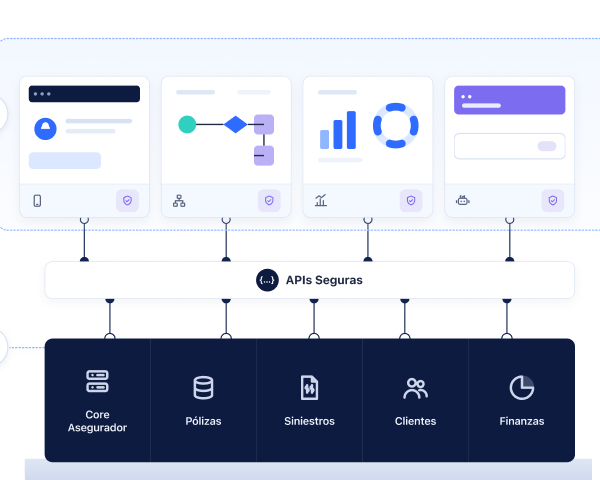
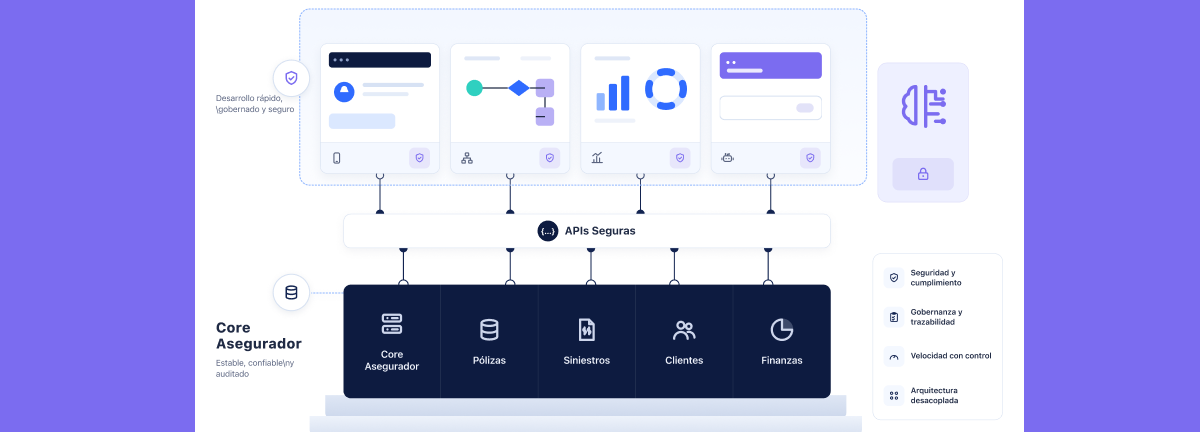
To maintain stability without slowing digital progress, architecture and IT teams are evolving from monolithic models toward decoupled architectures
For technology teams in the insurance industry, the primary mandate has always been stability. Core systems, transactional platforms, and policy databases represent the operational backbone of the company. These architectures are designed to process massive volumes of data with high precision and comply with strict regulatory requirements, but not to adapt to weekly changes or iterate digital experiences in real time.
This reality places technology and architecture leaders in a complex position. On the one hand, executive leadership and business teams demand rapid integrations, self-service portals, and the adoption of tools based on artificial intelligence. On the other hand, the technical infrastructure requires caution, constant maintenance, and rigorous operational risk management.
The result is a recurring imbalance: most of the IT team’s time and budget is consumed by maintaining the stability of existing systems, leaving very little room for developing new capabilities.
The Real Cost of Shortcuts and the Problem with Large-Scale Replacement
Faced with the urgency of responding to business demands, the industry has tried different approaches, most of them with mixed results:
- The full replacement strategy (Big Bang): For years, the definitive solution was believed to be migrating the entire environment to a more modern insurance core. In practice, these projects have proven to involve exhausting timelines, escalating costs, and a level of operational risk that few organizations can afford to take on.
- Custom development without a unified framework: Attempting to address each requirement with independent developments often results in a fragmented architecture. The proliferation of ad hoc connectors, scattered business logic, and a lack of standards ultimately creates technical debt that slows down future development even further.
- The use of AI without governance (Vibe Coding): Adopting generic coding assistants without a controlled environment generates software fragments that are difficult to audit, lack standardized documentation, and operate outside corporate security frameworks.
"Various reports from technology research firms indicate that more than 70% of the IT budget in traditional financial institutions and insurance companies is allocated exclusively to operating and maintaining legacy systems, limiting their ability to respond to new digital competitors."
Architecture Analysis: Where Should Innovation Be Built?
To maintain stability without slowing digital progress, architecture and IT teams are evolving from monolithic models toward decoupled architectures
An Agile and Controlled Development Environment for Legacy Systems
The sustainable alternative for insurance companies is not to dismantle what already works or respond with improvised patches, but to adopt an application development platform that acts as a controlled acceleration environment.
Under this approach, the insurance core, ERPs, and transactional databases remain the single source of truth. On top of them, new applications, self-service portals, and workflows are built independently on an architecture designed for rapid evolution.
This is where Deyel positions itself, offering an Enterprise Low-Code development platform designed for highly demanding environments. The solution enables organizations to connect diverse systems (AS/400, mainframes, SAP, Oracle, or proprietary cores) and build mission-critical applications while reducing manual coding time.
In addition, the inclusion of DIANA, its Artificial Intelligence Agent for the development lifecycle, helps technical teams generate foundational structures.
Unlike open AI tools, DIANA operates within the platform’s security, permissions, and audit framework, ensuring that every generated component is auditable and complies with the industry’s regulatory requirements.
In this way, IT can resolve the operational dilemma: delivering functional software at the speed the business requires, maintaining strict control over the architecture, and protecting the stability of core systems.
Deyel enables IT teams to build and deploy insurance applications without accumulating technical debt or compromising core systems.
