


Leaders in the AI Era: How to Build What the Business Really Needs
September 3, 2026
The CIO’s Dilemma in Insurance: How to Innovate When 80% of the Budget Goes to Maintaining Operations
September 3, 2026AI and Low-Code: The End of Repetitive Code in the Enterprise Backend
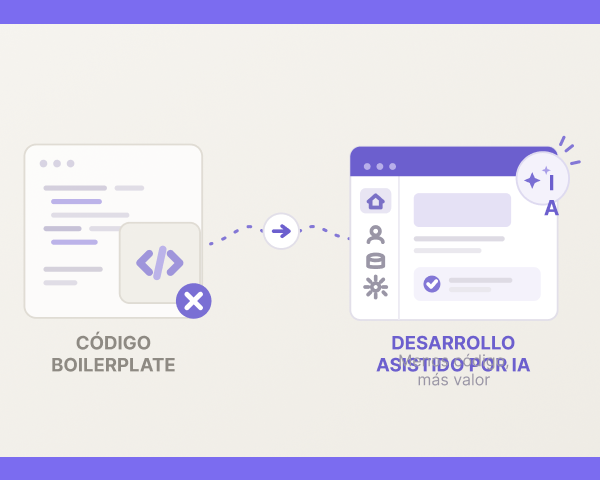
There is an open secret in enterprise software development: engineering teams spend a significant portion of their time not innovating, but writing repetitive infrastructure code. Data capture forms, user authentication, approval workflows, and integration logic with legacy systems consume weeks of work that should be dedicated to solving real business problems.
In the industry, this mechanical work is known as boilerplate code (or repetitive code). For years, companies had to choose between two unfavorable options: purchasing rigid, packaged software that failed to adapt to their processes, or hiring traditional software factories to build everything from scratch, taking on high costs, endless delivery timelines, and ongoing dependency for every change.
Today, the combination of Artificial Intelligence and AI-assisted Low-Code development platforms opens up a third path: automating the "digital plumbing" so that business and technology teams can focus on creating value.

The Digital Plumbing Trap
When an organization decides to launch a new supplier portal, claims management system, or operations app, more than 60% of the initial effort is not dedicated to the company’s unique business logic. Instead, it goes toward:
- Configuring user permissions and roles.
- Designing basic data entry interfaces.
- Writing connectors and validating formats for the database or ERP.
- Creating queries and intermediary APIs.
This boilerplate code not only delays launch; it also becomes a significant maintenance burden. Every line of code written by hand is another line that must be audited, updated, and fixed when something breaks.
If the Platform Handles the Core Infrastructure, What Does the Technical Team Focus On?
There is a common misconception that automating the creation of screens or the foundational architecture of a project reduces the company’s control or diminishes the role of developers. The opposite is true: the platform provides the engine and infrastructure safeguards so that the technical team can stop wasting time "making bricks" and become a strategic partner to the business.
With a platform that already handles core security and connectivity, the technical team can use it as leverage to ensure five key outcomes:
- Customization without limits or rigidity: Adapt workflows, screens, and logic to 100% of the company’s operations, avoiding both the rigid constraints of closed tools and the slow pace of traditional development from scratch.
- Seamless application connectivity (Integration): Configure real-time communication between new applications and the existing ERP or CRM through prebuilt connectors, avoiding information silos and delays.
- Protecting the most valuable asset (Data Governance): Model clean information structures and apply access policies on top of the platform’s native security layers.
- Automation of complex rules: Orchestrate visual workflows that reflect business exceptions and the unique business rules that make the company competitive.
- Long-term stability: Design applications on an architecture that is already prepared to scale in speed, performance, and regulatory compliance.
What the Data Says: The Urgency of Freeing Up Technical Capacity
The need to rethink how engineering time is invested has become an operational priority. According to data from consulting firm Gartner (The Path to Human-AI Integration in the Workforce, 2026), the technical skills gap and lack of efficiency remain the main obstacles facing organizations:
The report highlights three realities of today’s market:
- AI skills gap: Half of CIOs say that demand for professionals skilled in AI and data disciplines is growing much faster than the supply of qualified talent. The solution is not to seek more people to perform manual tasks, but to elevate the strategic capabilities of the existing team.
- Lack of guidance: Only 6% of employees have received clear guidance on which skills they need to develop for this new environment, slowing technology adoption.
- Friction in daily workflows: 41% of enterprise technology users struggle every day to integrate intelligent tools into their workflows without disrupting their pace. To overcome this barrier, the key is to adopt integrated development environments where automation and governance coexist in a single place.
What Should Be Built from Scratch and What Should Be Orchestrated?
Not every application should be approached in the same way. Knowing what to delegate to automation layers is the first step toward a mature technology strategy:
From Execution to Strategy
Automating the basic construction of applications does not mean reducing rigor in software development. On the contrary: when modern environments with integrated governance, security, and Artificial Intelligence are used, the right balance is achieved:
- The Business team can iterate applications in days instead of months.
- The Technology team eliminates the burden of repetitive tasks, retains intellectual property and control over the architecture, and focuses its team on projects that deliver real impact.
The goal of modernizing solution development is not simply to produce more in less time, but to eliminate technical friction in order to build the applications the business needs to grow.
