


The Invisible Risk in Procurement: Do You Really Know Who You’re Doing Business With Today?
August 12, 2026
AI and Low-Code: The End of Repetitive Code in the Enterprise Backend
September 3, 2026Leaders in the AI Era: How to Build What the Business Really Needs
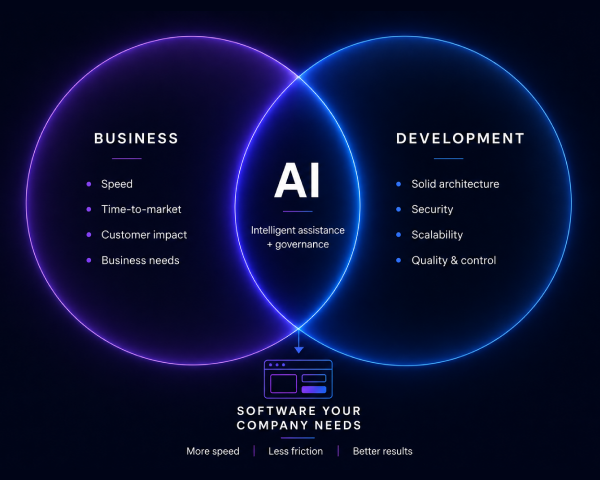
Few things create more frustration in a company than the difference in pace between two key areas: leadership, which needs to launch solutions to market today, and the engineering team, which deals with technical complexity to make sure things do not break.
The arrival of Artificial Intelligence in software development does not magically change this dynamic, but it does create a new playing field. When used well, AI is not there to replace programmers, but to take repetitive and mechanical work off their shoulders. The goal is clear: enable developers to move from writing routine code to designing high-impact solutions, while the company gains speed without accumulating technical disorder.
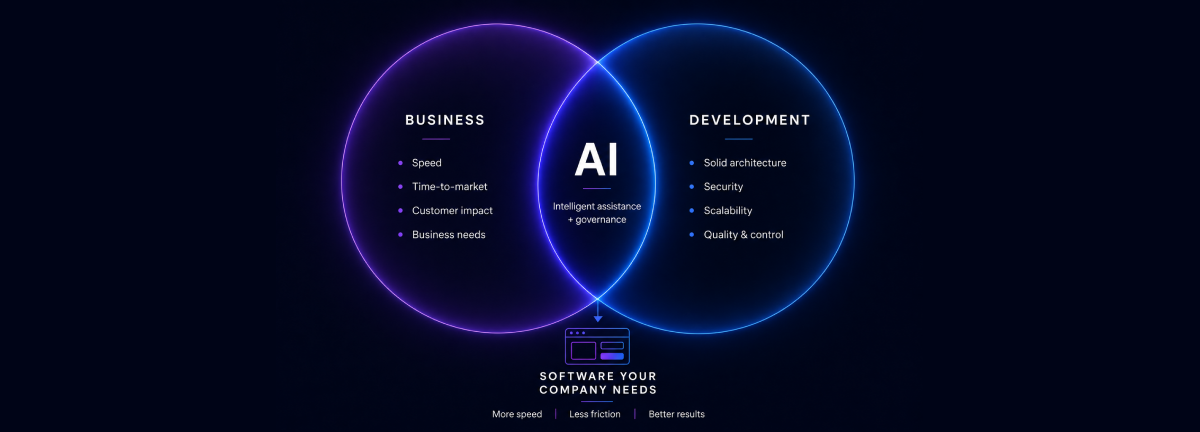
The New Alignment: What Does Each Area Really Need?
For the adoption of AI tools to work in practice and not remain just a good intention, it must address the daily challenges of each role:
1. The Business Perspective (CEOs, Innovation Directors, PMs)
- What they are looking for: Faster time-to-market, lower development costs, and a direct impact on the customer.
- How AI contributes: It makes it possible to move from an idea or business requirement to a functional prototype in days, reducing the weeks of waiting between design and the first real test.
2. The Technical Perspective (Developers, Tech Leads, CTOs)
- What they are looking for: Reduce technical debt, avoid tedious tasks (such as performing basic tests manually, writing documentation, or building boilerplate code), and focus on architecture and complex logic.
- How AI contributes: It acts as an execution assistant. The developer takes the lead on the project: reviewing logic, auditing security, and ensuring the system is scalable, while AI accelerates the construction of more standard code blocks and modules.
The Real Bottleneck: The Gap Between Tools and Culture
Despite the enthusiasm surrounding new tools, technology always moves faster than companies’ internal processes.
A recent study by Gartner (The Path to Human-AI Integration in the Workforce, January 2026) puts numbers to this challenge:
By 2030, 75% of technology work will be performed by professionals in AI-assisted environments, while only the remaining 25% will be carried out autonomously by technology.
Gartner points out that the real obstacle is not a lack of tools, but a lack of organizational readiness:
- Lack of direction: 94% of employees feel they have not received clear guidance on which skills they need to develop for this new context (only 6% say they have clarity).
- Friction in daily workflows: 41% of users admit they struggle to integrate AI into their daily tasks without disrupting their workflow.
- Leadership uncertainty: Only 2 out of 10 technology leaders feel their teams are ready to make the most of these tools.
Three Ways to Approach AI (and Their Consequences)
The way strategic leadership approaches this adoption makes the difference between creating value and accumulating frustration. Gartner summarizes the impact based on the organization’s stance:
From Intention to Practice
Incorporating AI into the development lifecycle is not simply a matter of buying licenses and expecting miracles. It requires reviewing how teams work, training them, and establishing clear governance rules to ensure that the generated code is secure, maintainable, and scalable.
At the end of the day, the measure of success is not how much code can be produced in less time, but something much simpler: building exactly the software the business needs to grow.
