


Is Your Procurement Department a Cost Center or a Value Driver?
August 12, 2026
Leaders in the AI Era: How to Build What the Business Really Needs
September 3, 2026The Invisible Risk in Procurement: Do You Really Know Who You’re Doing Business With Today?
Imagine this scene: a key contract expires without anyone noticing, a tax penalty arrives because the company was operating with a suspended supplier, or a production line is halted at one site because the “usual” supplier failed to deliver.
When the root cause of these failures is investigated, the answer is rarely a lack of professionalism from the team. The real culprit is information fragmentation.
In growing companies or those with multiple locations, day-to-day supplier management often turns into an archipelago of data: outdated Excel spreadsheets, endless email threads, contracts stored in local folders, and informal approvals. This disorder creates an invisible risk that directly threatens the company’s profitability and compliance.

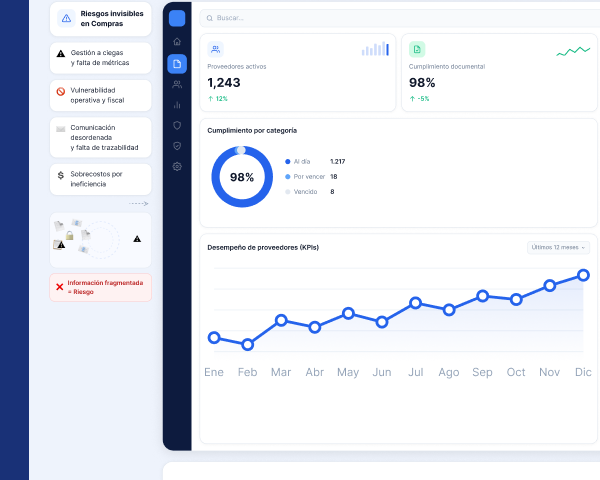
The 4 symptoms of a blind supply chain
If your procurement department deals with scattered data on a daily basis, it is likely experiencing some of these symptoms:
- Blind management and lack of metrics: Without a centralized record, evaluating whether a supplier is delivering on time and in full depends on individual perceptions rather than objective data. It becomes nearly impossible to measure real performance KPIs.
- Operational and tax vulnerability: Expiring tax certificates, licenses, or insurance policies do not announce themselves. Operating with expired documentation exposes the company to fines, penalties, and the latent risk of working with suppliers that are not formally approved.
- Disorganized communication and lack of traceability: When requests, invoices, and claims move through personal email inboxes, the trail of agreements is lost. If a team member is absent, the context of the relationship disappears with them.
- Extra costs caused by inefficiency: Lack of visibility across multiple locations leads to duplicate purchases, lost volume discounts, or the need to hire more expensive emergency solutions because a renewal was not anticipated in time.
Self-Assessment: Risk Exposure Matrix
Assess your department’s current situation by answering these 4 key questions:
Supplier Qualification: Can you guarantee that 100% of the active suppliers across all your locations have valid tax and legal documentation?
Continuity: Do you receive automatic alerts 30 days in advance before a critical contract or insurance policy expires?
Visibility: If an auditor asks for the complete history of interactions, invoices, and evaluations for a supplier, can you consolidate it in less than 5 minutes?
Standardization: Do all your locations or subsidiaries apply exactly the same criteria when onboarding and evaluating a supplier?
If you answered "No" or "I'm not sure" to 2 or more questions, your operation is exposed to a high level of invisible risk.
From Data Chaos to Full Traceability
Mitigating these risks is not about requiring the team to manage more spreadsheets, but about establishing a single source of truth. Moving from reactive management —focused on putting out fires— to a preventive approach requires end-to-end visibility across the operation.
Monitoring the supplier’s entire lifecycle means managing everything from onboarding and background validation to the continuous tracking of deliveries and the expiration of critical documentation.
(Excel / Email)
Control, Traceability, and Visibility with Deyel Vendor Management
Managing a diverse and distributed supplier network does not have to become an administrative nightmare. Deyel Vendor Management centralizes and automates every aspect of your supplier relationships.
Through an architecture designed to bring order to complexity, the solution enables you to:
- Centralize information in a single source: Eliminate scattered spreadsheets and lost emails. All supplier documentation, contracts, and data are stored in one accessible and auditable repository.
- Automatic compliance alerts: The system detects and notifies you in advance of expiring contracts, insurance policies, and tax certificates, helping prevent account closures or unintended operational disruptions.
- Organized multi-site ecosystem: Standardize supplier qualification and approval rules across all company plants or branches, ensuring that no location operates with an unauthorized supplier.
- Dashboards and clear metrics: Monitor each supplier’s performance in real time through compliance KPIs, enabling sourcing decisions based on hard data rather than intuition.End-to-end traceability: Every interaction, uploaded document, or validation is recorded with a date and responsible party, ensuring seamless audits with no surprises.
Take Control Before an Incident Occurs
The cost of poor supplier management rarely appears on the initial invoice; it emerges later in the form of fines, delays, litigation, or reputational damage.
Mitigating invisible risk requires turning uncertainty into visibility. With solutions such as Deyel Vendor Management, your team gains the traceability needed to protect the organization, make informed decisions, and scale operations with confidence.
