


Prompt-First: The Development Approach That Bridges the Gap Between Idea and Execution
August 10, 2026
Is Your Procurement Department a Cost Center or a Value Driver?
August 12, 2026AI in Development: How to Stop Shadow AI and Empower the Business Without Losing IT Control
There is a silent but destructive clash within modern organizations: the relentless speed demanded by the business versus the rigor of security and governance that the IT department must ensure.
When operational teams feel that IT projects take months to execute, they look for shortcuts. They purchase licenses for niche software without IT's knowledge, manage sensitive data in shared spreadsheets, and, more recently, adopt public Artificial Intelligence tools without any oversight.
This phenomenon, historically known as Shadow IT and, more recently, as Shadow AI, does not arise from bad intentions, but from teams' urgent need to work with agility. However, the hidden cost to the business is extremely high: cybersecurity risks, confidential information leaks, unmanageable silos, and "orphaned code" that is impossible to maintain in the long term.
The Invisible Cost of Failing to Provide Agile Alternatives
Trying to slow technology adoption through bans and restrictions is no longer a viable option. Market data reveals the scale of the challenge:
- Inevitable Adoption: According to Gartner's global projections, by 2027, 75% of employees will use unauthorized AI tools or Shadow IT technologies in their daily work if IT does not provide flexible, officially approved alternatives.
- Greater Financial Impact: IBM cybersecurity reports highlight that breaches linked to Shadow IT result in significantly higher average costs and take nearly 20% longer to identify and contain compared with incidents involving managed systems.
The challenge for technology leaders is no longer to restrict innovation, but to create an environment where the business can innovate quickly while operating within the governance framework and rules required by the organization.
Decentralized AI vs. Governed Environments
To resolve the tension between speed and control, it is essential to understand what happens when AI is used in isolation versus when it is integrated into a governed architecture:
Toward a Collaborative Model: From Restrictive Control to Strategic Enablement
When an organization provides a secure framework that interprets natural language and generates functional components in minutes, the temptation to turn to Shadow AI naturally disappears.
To achieve this transition, leading technology strategies are adopting three key pillars:
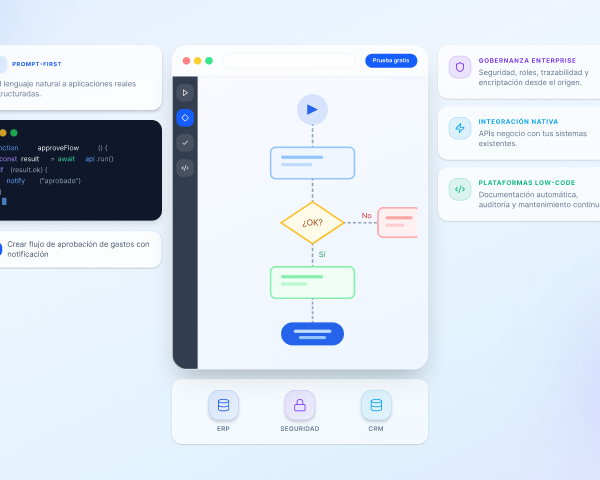
- Common Language (Prompt-First): Enable operational teams to describe their requirements in natural language to generate real, functional prototypes that IT and Business can co-design without friction.
- Governance by Design (Security by Design): Apply granular access controls, role management, audit logs, and environment separation from the very first interaction or prompt, avoiding the need to rebuild security at the end of the process.
- Human in Control (Human-in-the-loop): Ensure that AI accelerates development and logic generation while critical decisions and final approval remain under human supervision.
True Agility Doesn't Eliminate Control
Hitting the brakes doesn't eliminate the need for change; it only pushes people to seek alternative—and often dangerous—routes. The solution to closing the gap between IT and Business is not prohibition, but technological alignment.
By combining Prompt-First development models with Low-Code architectures—the approach on which platforms like Deyel build their working ecosystems with agents such as DIANA—companies can transform what was once an internal conflict into their greatest driver of operational agility.
