



Is Your ERP Holding Back Supplier Management? How to Gain Control and Agility Without Changing SAP
August 10, 2026
AI in Development: How to Stop Shadow AI and Empower the Business Without Losing IT Control
August 10, 2026Prompt-First: The Development Approach That Bridges the Gap Between Idea and Execution
There is a massive gap between the vision of digitizing a business and the reality of achieving measurable operational impact.
Most organizations are stuck in a constant proof-of-concept cycle: isolated digitalization projects, no-code tools disconnected from core systems, or custom developments that take months (or years) to go live. At best, they are temporary fixes. At worst, they create information silos and frustration across teams.
To compete today, businesses don't need "more isolated apps." They need technology and process orchestration to be embedded into the way people work every day.
Why do most digitalization initiatives fall short?
It's not because of a lack of technology; it's because of the friction between idea and execution.
An operational process breaks down when business logic lives in users' heads, but the software required to execute it depends exclusively on an overloaded IT team. Facing a "blank screen" and having to model every page, entity, and business rule from scratch consumes critical time.
Niche tools or massive spreadsheets end up filling that gap, creating processes that are fragile, opaque, and difficult to scale.
This is exactly where the rules of the game change: digitalization isn't just about building interfaces; it's about moving from idea to production-ready application without friction.
The new paradigm: Prompt-First Low-Code with Deyel
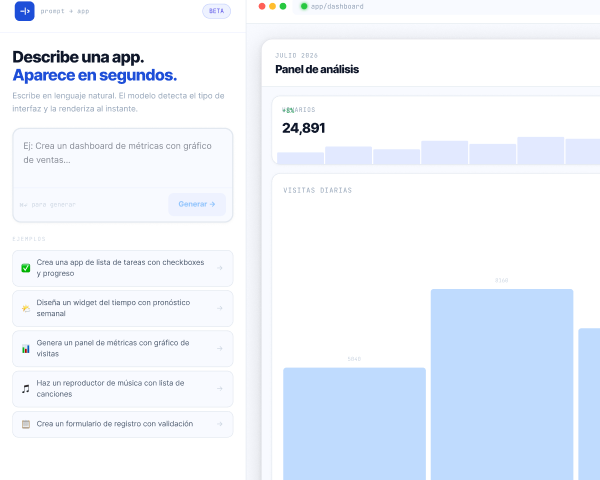
Deyel adopts a Prompt-First approach, radically transforming the enterprise software development lifecycle.
Instead of starting from scratch with complex visual tools, development begins directly in natural language:
- Prompt-First (From idea to application in seconds): You describe what your process needs. DIANA, the AI integrated into Deyel, interprets your intent and automatically generates data entities, attributes, pages with their visual layouts, and initial business rules.
- Low-Code / No-Code Refinement: Building on this solid AI-generated foundation, business and IT teams collaborate in a visual environment to adjust page designs, add advanced rules, and customize the user experience.
- Enterprise Orchestration and Integration: Connect the new solution to the company's core systems (SAP, CRMs, databases, or legacy systems), ensuring system coexistence and end-to-end flow integration.
- Governance and Traceability: IT maintains full control over permissions, security standards, and regulatory requirements, preventing the creation of "orphaned code" or technical debt.
The Prompt-First approach doesn't replace Low-Code; it enhances it. It eliminates blank-page paralysis and reduces to minutes what previously took weeks of initial modeling.
Real operational impact: Orchestration that translates into numbers
This isn't theory; it's what happens when intelligent, AI-powered process orchestration is integrated into the heart of the enterprise:
- Financial Services and Insurance: A 70% reduction in approval and processing times for complex requests by combining Prompt-First application generation with automated validation rules.
- Operations and Logistics: Elimination of 90% of manual data entry, dramatically shortening the time between the idea for a new process and its operational implementation.
- Quality Management and Compliance: 100% visibility into audits with end-to-end traceable workflows, reducing errors caused by non-standardized processes to zero.
The gap closes when AI and Low-Code work together
Digital delays don't have to be the norm. For enterprises seeking true agility, the combination of Prompt-First and Low-Code offers the perfect balance between the speed the business demands and the governance IT requires.
By turning words into intelligent applications, operational pages, and governed processes, a platform like Deyel doesn't just accelerate development: it transforms the way operational value is created.
