



Agentic AI in the Enterprise: How to Scale Artificial Intelligence Without Losing Governance
November 6, 2026
Claims Settlement: From an Overloaded Inbox to Resolution in Minutes
November 6, 2026Data-First Architecture: How to Build Robust, Scalable Enterprise Applications
Digital acceleration in organizations often runs into a less visible problem than development speed: the fragility of the architecture on which applications are built.
Creating new interfaces, automating tasks, or incorporating artificial intelligence can speed up delivery. But if business data, processes, rules, and integrations are not properly structured, that speed can amplify operational inconsistencies.
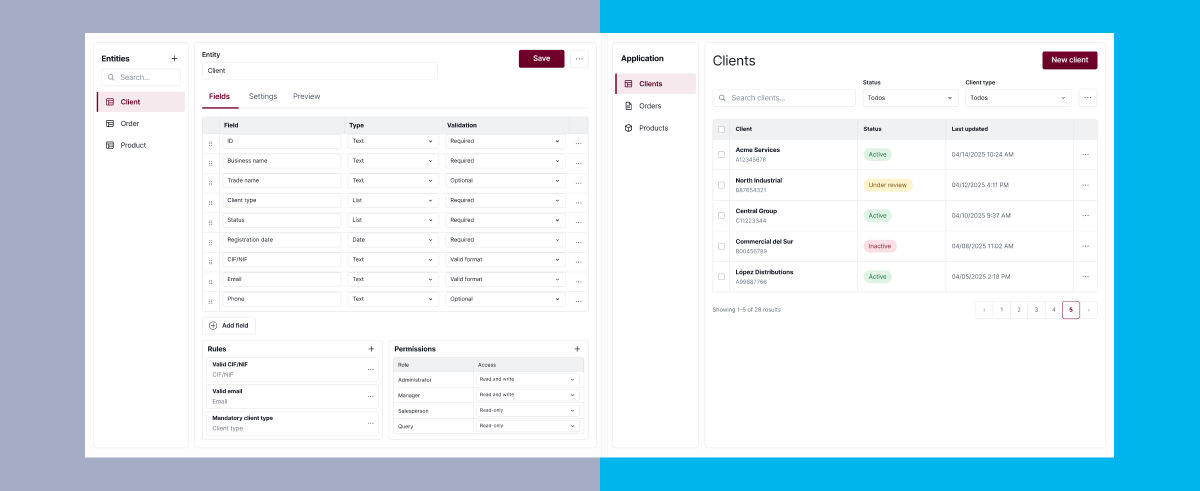
That is why building scalable enterprise applications takes more than developing faster. It requires a governed foundation that allows information, business logic, and processes to evolve consistently. In this architecture, data plays a central role—not as an isolated asset, but as the element that connects processes, decisions, permissions, and integrations within each application.
The hidden cost of disorder in enterprise architecture
The widespread use of isolated solutions, non-standardized databases, and informal workflows creates an invisible liability that directly affects strategic decision-making. While traditional technical debt undermines code maintenance, inconsistencies in data and process architecture affect day-to-day operations.
When the foundation on which applications run lacks structure:
- Time is lost to validation: Teams spend more time checking whether data is correct or where a process stands than carrying out valuable work.
- Errors cascade: An incorrect record or rule at the source spreads across interfaces, workflows, and corporate reports, leading to executive meetings where different departments present conflicting figures.
- Integration becomes more complex: Each new system requires ad hoc connectors to interpret heterogeneous data and processes.
As Gartner notes in its assessments of enterprise software ecosystems:
"More than 60% of automation and analytics initiatives fail to achieve their business objectives because of pre-existing deficiencies in the quality, lineage, and structure of the underlying architecture."
Comparing approaches
How solutions are structured determines the long-term sustainability and total cost of ownership (TCO) of corporate systems:
| Criterion | Fragmented development | Governed development |
|---|---|---|
| Data | Duplicated and untraceable | Consistent, controlled models |
| Processes | Logic distributed across systems | Modeled and traceable processes |
| Business rules | Embedded in isolated applications | Centralized and maintainable |
| Integrations | Ad hoc connectors | Reusable APIs and services |
| Security | Added separately to each solution | Built into the design |
| Evolution | Every change creates friction | The solution evolves on a shared foundation |
| AI and automation | Operate on fragmented information | Operate within a governed context |
5 pillars for structuring a governed application architecture
Turning internal software development into a strategic differentiator requires a solid, structured methodology:
- Model the business correctly: Define entities, relationships, and shared criteria to prevent conflicting interpretations across departments.
- Structure processes and rules: Clearly define how information flows and which operational decisions are made at each stage of the lifecycle.
- Govern data and access: Build in automated validations, end-to-end traceability, granular permission assignments, and clear responsibilities from the outset.
- Design reusable integrations: Avoid point-to-point or ad hoc connections between applications by using APIs and shared data models.
- Build on a shared architecture: Enable applications, automations, and artificial intelligence to evolve organically on the same foundation.
The principle of governance by design
Forrester Research sums it up clearly in its reports on development platforms: "Application delivery agility loses its value if it is not supported by a structure that ensures security, data integration, and governance across the process lifecycle.”
Business impact: the return on investment of a governed model
Adopting a governance-centered enterprise application architecture delivers measurable operational returns:
- A 40% to 60% reduction in the time required to integrate and deploy new enterprise applications.
- A significant decrease in operational errors caused by duplicate records or inconsistent business rules.
- Greater agility in compliance audits, thanks to consolidated traceability records (logs) and access governance.
- Readiness for AI and automation: The ability to incorporate advanced models using reliable data and context.
Why we address this topic at Deyel
At Deyel, we understand that application development is an architectural challenge, not just a matter of speed.
A sustainable solution needs to bring data, processes, rules, integrations, permissions, and user experience together within a shared structure. This foundation allows applications to evolve without sacrificing traceability, security, or control as their complexity grows.
That is why the discussion around Data-First architecture is about more than organizing information. It is about building better applications on a foundation designed to grow, integrate, and adapt to new forms of automation and artificial intelligence.
A solid foundation for digital evolution
Operational agility should not come at the expense of information integrity or architectural stability. By establishing a foundation centered on the governance of data, processes, and rules, companies can build the infrastructure they need to scale safely toward advanced models of automation and operational intelligence.
