


The Agentic Era: From Answering Questions to Executing Operations
November 6, 2026
Data-First Architecture: How to Build Robust, Scalable Enterprise Applications
November 6, 2026Agentic AI in the Enterprise: How to Scale Artificial Intelligence Without Losing Governance
Most enterprise applications were designed around deterministic logic: a user performs an action, the system applies predefined rules, and the process moves forward along a known path. The arrival of large language models (LLMs) introduced natural language understanding and synthesis capabilities, but integrating a conversational assistant or consuming an external API does not turn a system into an intelligent platform.
This is where agentic AI makes the difference: intelligence stops operating as an isolated tool and becomes directly integrated into the application architecture, participating in the execution of the business itself.
What is agentic AI and what is it used for?
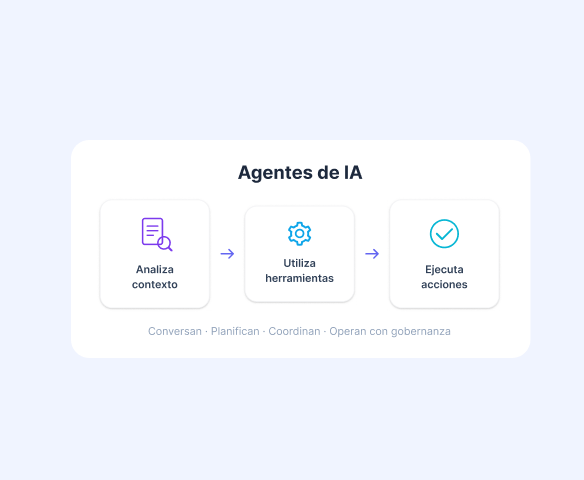
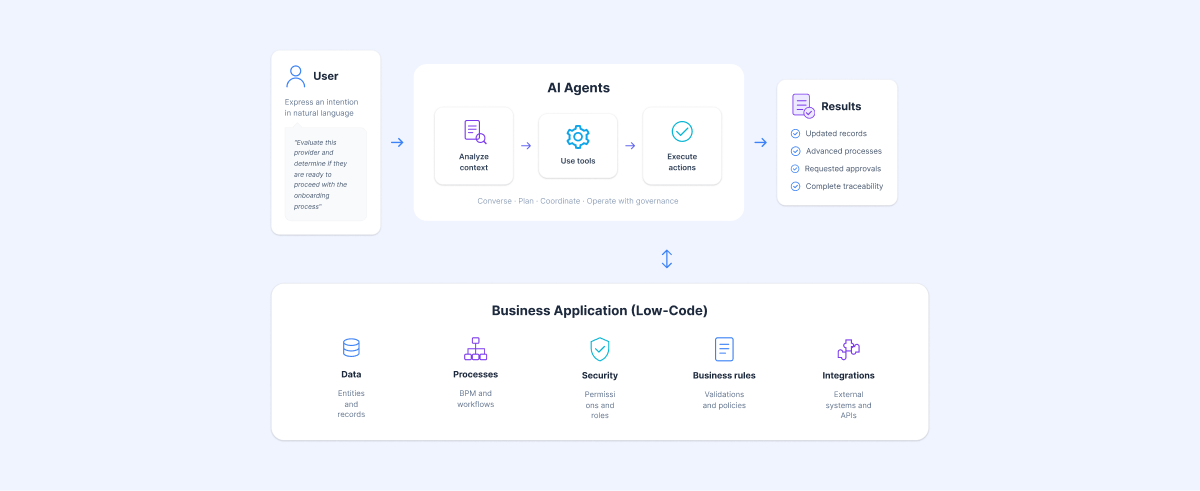
Unlike traditional generative models —designed primarily to answer questions or generate text— intelligent agents can interpret context, reason about an objective, use enterprise tools, and collaborate in the execution of tasks.
An agent does not replace the system’s logic: it works with the existing entities, processes, permissions, and rules. The intelligence lies in knowing how to coordinate those business objects, not in replacing them.
This evolution introduces a key operational distinction:
The user operates the system directly to complete each step.
The user expresses an intent or objective, and the agent uses the application’s authorized capabilities to achieve it.
A Real-World Operational Scenario: Supplier Evaluation
To understand the leap in capability between the two approaches in a supplier onboarding process:
- With an isolated assistant: The analyst uploads a document to a dialog window. The model analyzes the text and responds that the supplier meets the requirements. However, the analyst must leave the chat, log in to the ERP or BPM system, locate the record, enter the information, and manually move the approval workflow forward.
- With an integrated agent: The analyst assigns an objective: "Evaluate this supplier and determine whether it is eligible to move forward with the onboarding process". The agent identifies the entity on the platform, analyzes the attached documentation, detects missing requirements, executes the risk assessment rules, updates the records in the application, and advances the process by requesting the corresponding human approval.
Isolated Assistant vs. Integrated Agent
For IT and business teams, distinguishing between these two approaches is essential to avoid failed efforts in innovation projects:
The Market Pulse: Gartner, Deloitte, and Forrester
Leading research firms confirm that intelligent agents are becoming a strategic priority for enterprise software, while also warning about the challenges involved in their implementation:
Projected that 40% of enterprise applications will integrate task-specific agents by the end of 2026, up from less than 5% in 2025. However, the firm also predicts that by 2027, 40% of organizations will scale back or retire autonomous agents due to governance gaps identified after production incidents.
Found that 74% of IT and business leaders expect that, within the next four years, nearly half of their operational processes will be redesigned or rebuilt around AI agents. Despite this expectation, only 15% report having scaled multi-agent deployments in production, identifying the lack of unified data (72%), difficulties governing AI (70%), and integration complexity (67%) as the main obstacles.
Highlights context as a critical condition for success. Agents need access to a unified and governed context layer —data, metadata, business concepts, and processes— in order to make decisions and execute actions consistently.
Where Does Agentic AI Create Value?
Integrating agents creates efficiencies across multiple areas of the organization:
- IT and Development: Accelerates the software delivery cycle by combining assisted generation with reusable cognitive components, reducing the need to build custom integrations for each language model.
- Operations and Back Office: Automates exception management, data reconciliation across systems, complex document processing, and compliance validation in financial or procurement processes.
- Customer Service and Support: Enables complex requests to be resolved end to end by performing identity validations, consulting operational knowledge bases, and recording transactions in legacy systems through APIs.
Principles for Governed Enterprise Adoption
To scale the use of agents without compromising security or operational continuity, organizations should guide their architecture according to four core principles:
- The application sets the rules: The agent reasons and coordinates actions, but the application determines which tools it can use, under which permissions and conditions, and records each execution in an auditable manner.
- Centralized governance independent of the prompt: Defining critical permissions or restrictions solely within natural language instructions is a fragile practice. Security policies, sensitive data management, API consumption limits, and role assignment should be managed at the system infrastructure level.
- Autonomy proportional to risk: Not every action requires the same level of supervision. An analytical query may be executed autonomously, while a financial approval or contractual change should require human oversight (Human-in-the-Loop). Governance defines the scope of autonomy according to the impact of the operation.
- Technological sovereignty and independence: The rapid evolution of language models requires decoupling agentic capabilities from the underlying provider. An adapter-based architecture makes it possible to switch or combine models (OpenAI, Gemini, Anthropic, or open-source options) based on cost, latency, or the specific requirements of each task, protecting the organization’s technology investment.
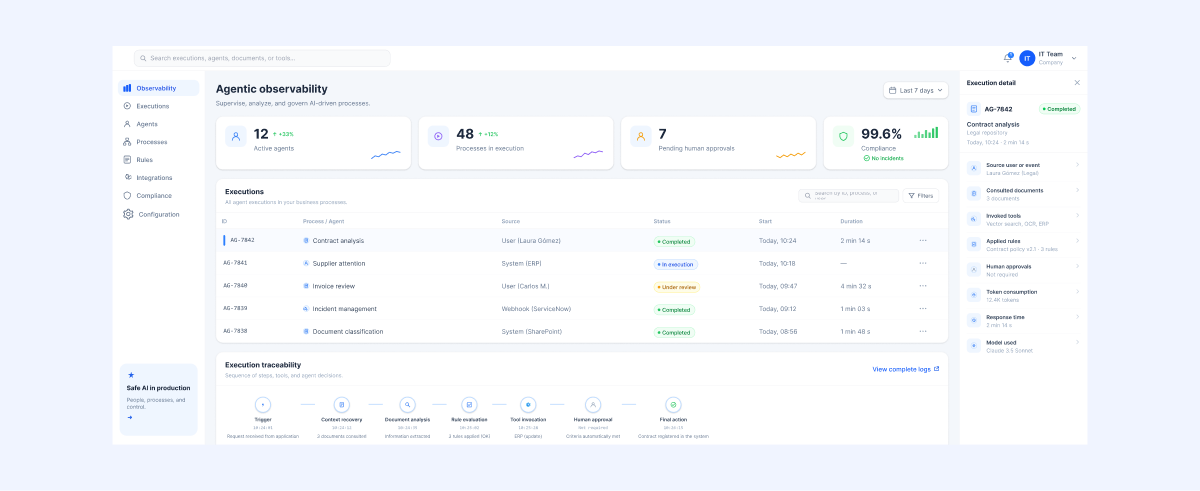
Visibility and Traceability: Operational Control for IT
The main barrier to agent adoption in enterprise environments is uncertainty about how they make decisions. For an IT team to validate the operation of agentic components, execution must be transparent and auditable.
Through observability consoles integrated into the platform, systems teams can maintain complete control over the environment:
- Identify the user or event that triggered the agent’s action.
- Inspect the context, documents, and data consulted during execution.
- Verify the tools invoked, rules evaluated, and human approvals received.
- Audit token consumption, response times, and the models used.
This traceability enables precise diagnostics, helps ensure regulatory compliance, and maintains the stability of the enterprise environment.
Adoption Roadmap: A Gradual Approach
The transition to an agentic architecture does not require immediately restructuring every system in the organization. The safest path follows a staged maturity model:
Deploy agents focused on a limited functional domain, with a defined set of authorized tools for accessing context, analyzing information, and executing controlled actions.
Integrate agents directly into workflows (BPM) and system events, enabling them to take responsibility for specific tasks or react to changes in application state.
Coordinate ecosystems in which different specialized agents collaborate with one another, delegating subtasks and sharing context within a common governance framework.
Enterprise applications already have data, rules, permissions, and process flows. Agentic AI does not need to replace that structure: it needs to understand it and operate on it in a governed way.
