



From a prototype idea to the production of an enterprise application
March 17, 2026
Is Your ERP Holding Back Supplier Management? How to Gain Control and Agility Without Changing SAP
July 28, 2026Insurance Companies: How to Go from Idea to a Mission-Critical Application
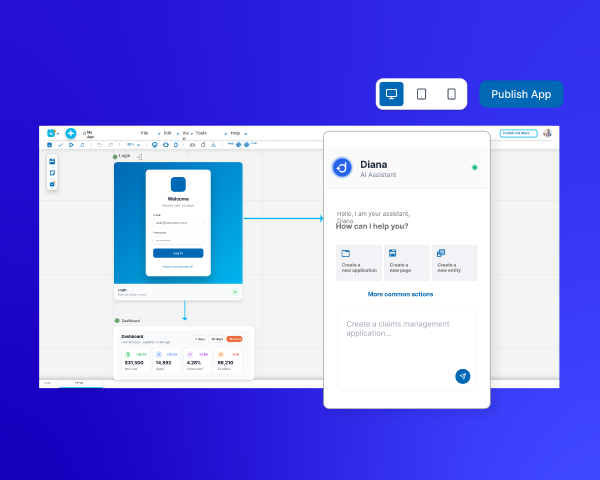
The challenge is no longer simply about digitizing a process. Insurance companies need to build and evolve applications connected to their core systems, capable of operating under strict security, traceability, and compliance requirements. Deyel combines AI and Enterprise Low-Code to take a business need from prompt to production within a single governed environment.
For years, the insurance industry focused on digitizing individual processes in isolation. Today, the strategic priority has shifted dramatically toward operational agility and the ability to orchestrate robust, end-to-end enterprise solutions.
This need collides with a complex reality for CIOs: a significant portion of IT budgets and team capacity is consumed by maintaining existing systems, managing integrations, and addressing technical debt, leaving fewer resources available for innovation.
Faced with the urgency of launching personalized products and streamlining claims management without adding complexity, the answer lies in transforming the software development lifecycle by combining the speed of Artificial Intelligence with the robustness of Low-Code.
Several market studies project that investment in Artificial Intelligence for insurance will grow at annual rates exceeding 30% over the coming years. Rather than being an experimental trend, AI is becoming a foundational capability for modernizing operations, improving policyholder experiences, and accelerating the development of digital solutions.
The Engine to Evolve Your Legacy
Legacy systems, fragmented data, and the difficulty of integrating new solutions remain some of the biggest barriers to innovation in insurance. In an environment where business rules and new products must adapt within minutes, relying on months-long IT backlogs severely limits an organization's ability to respond to market demands.
At the same time, the traditional strategy of replacing legacy transactional architectures to enable innovation has proven impractical, often resulting in lengthy implementation timelines and historically high failure rates. Low-Code platforms offer a different approach: acting as a flexible layer that unifies and integrates the existing technology ecosystem.
Through an API-first architecture and enterprise integration capabilities, Deyel enables applications to connect seamlessly with existing environments such as core systems, ERP, CRM, mainframes, AS/400, SAP, and Oracle. Deyel allows organizations to access, exchange, and update information through governed APIs and integrations, reducing unnecessary duplication while preserving core systems as the single source of truth. This architecture directly addresses some of the insurance industry's deepest operational challenges:
- Data Unification: Breaks down information silos by enabling bidirectional data exchange through modern API standards.
- Governance and Regulatory Compliance: Deyel provides traceability, access control, and auditing capabilities that record relevant user and system actions according to each application's configured policies. It precisely logs who performed each action, when it occurred, and which data, business rules, or process states were modified, facilitating internal control and ensuring compliance with external regulations.
- Operational Efficiency: Simplifies the creation of self-service portals and automated workflows. Automation and straight-through processing reduce manual intervention and significantly shorten processing times, particularly for simple, low-complexity claims.
Agile Development and Governance:
From Prompt to Production in One Platform
The key to enterprise modernization is not simply accelerating development, but eliminating the communication gap between business ideas and production-ready software while maintaining strict security controls.
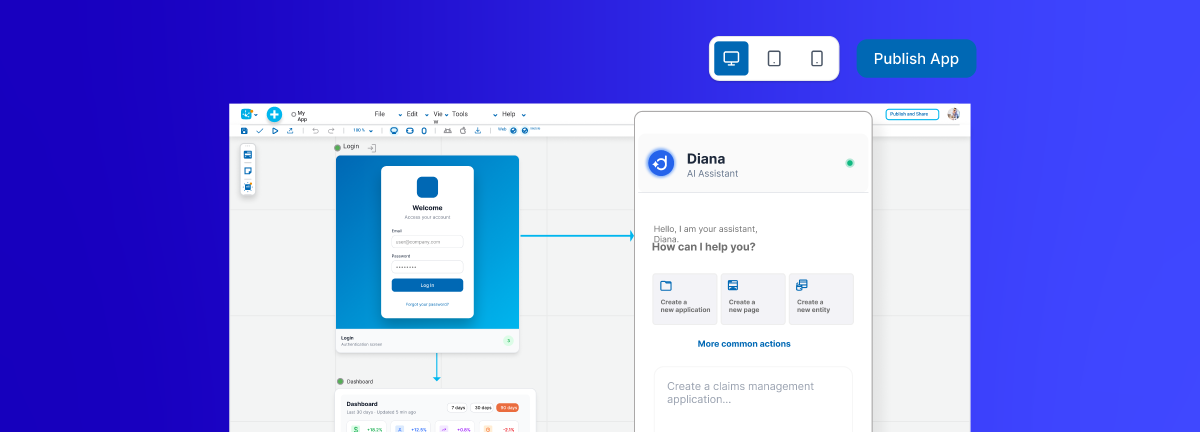
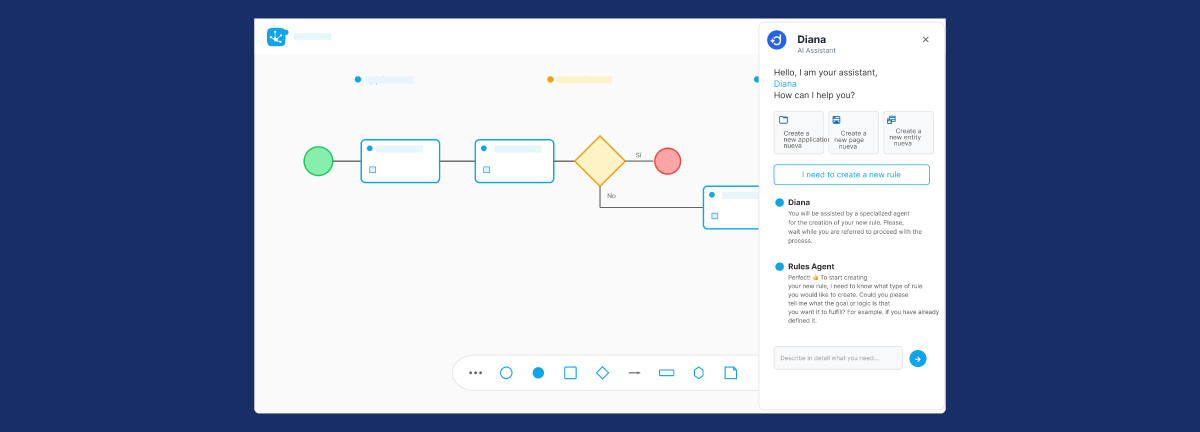
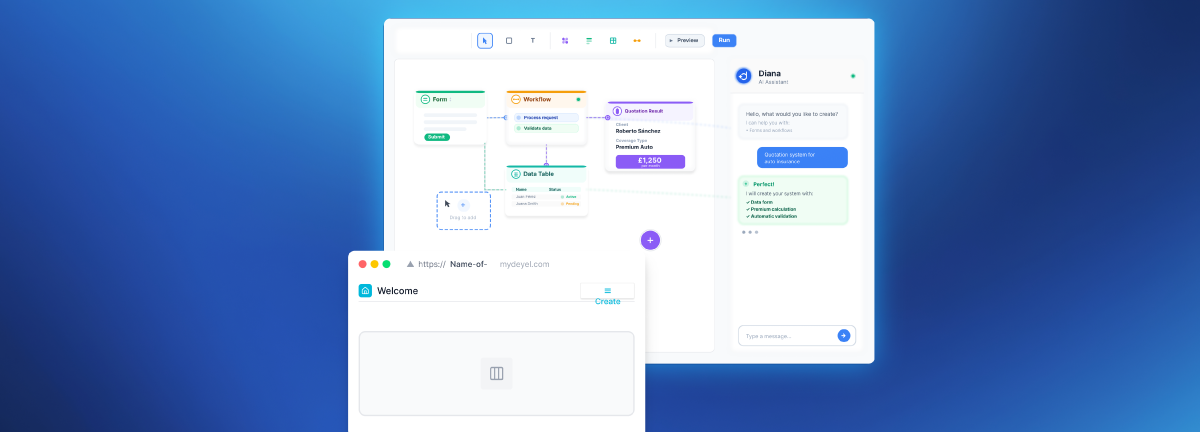
Deyel solves this challenge by integrating DIANA, a Multi-Agent Artificial Intelligence ecosystem that actively assists throughout the entire application development lifecycle. Unlike the Vibe Coding trend, where generic AI tools generate fragmented, unauditable logic, DIANA structures every visual component and business rule securely according to the platform's governance standards.
Its integration into the software lifecycle fundamentally transforms collaboration between Business and IT teams:
- Prompt (Requirements): The application designer defines what they want to build using natural language instructions. For example: "Create a homeowners insurance claims process with photo inspection." DIANA immediately interprets the technical intent.
- Development (Build): AI analyzes the request and automatically generates the application's foundation, including page views, entity models, and business logic. From there, teams can refine the solution using additional prompts or visual Low-Code modeling tools.
- Deployment (Production): What begins as a functional prototype can continue evolving within the same platform until it becomes a production-ready application, without discarding previous work or rebuilding from scratch. Depending on the scope and required integrations, this approach enables organizations to move from prototype in hours to an MVP in just a few weeks.
- Evolution (Extension): Applications are never static. As business needs evolve, the platform allows teams to extend existing solutions visually with Low-Code or through new conversations with DIANA using natural language prompts.
This assisted development approach ensures that AI proposes solutions, humans retain the final decision (Human-in-the-Loop), and every action is recorded, protecting operations in highly regulated industries with strict compliance requirements.
Balancing the Operational Matrix
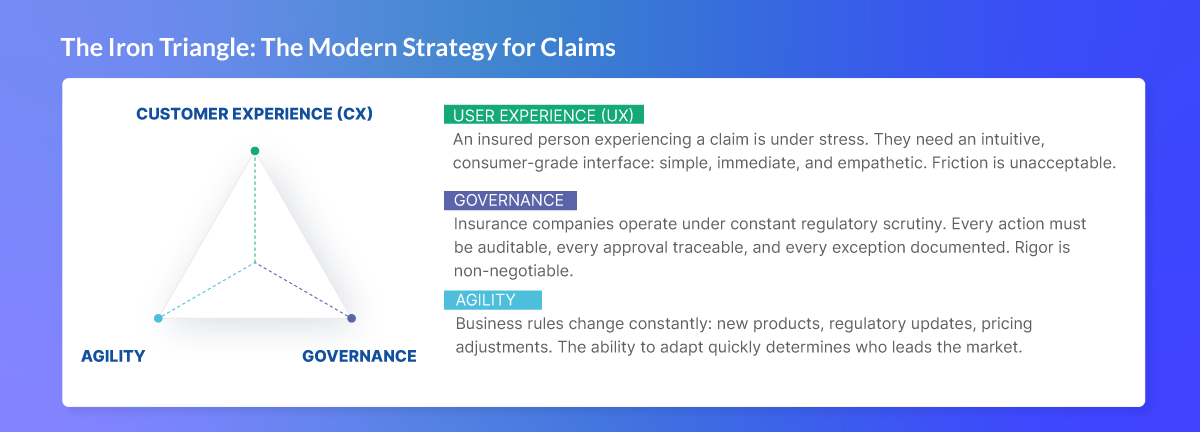
The convergence of visual development methodologies and Artificial Intelligence provides a critical balance for insurance organizations. While the Low-Code environment delivers governance, granular security, and strict adherence to corporate standards, AI acts as an accelerator throughout the software development lifecycle.
Together, they preserve the modern enterprise's "Iron Triangle", enabling organizations to simultaneously optimize Customer Experience (CX/UX), maintain strong IT Governance, and achieve the business agility today's market demands—without compromising any of these strategic priorities.
Accelerate Your Time-to-Market with Deyel for Insurance
Deploy mission-critical solutions from prompt to production in just weeks. Choose the delivery model that best fits your team's needs: Do It Yourself (we train your team), Co-Create (we collaborate on strategic phases), or Done for You (our experts build the solution).
