



Compras y proveedores a prueba de futuro: Customizar y extender sin riesgos
November 6, 2026
Low-Code and AI: Build Applications That Integrate People, Systems, and AI
November 6, 2026Lovable vs. Deyel: From Vibe Coding to Enterprise Applications
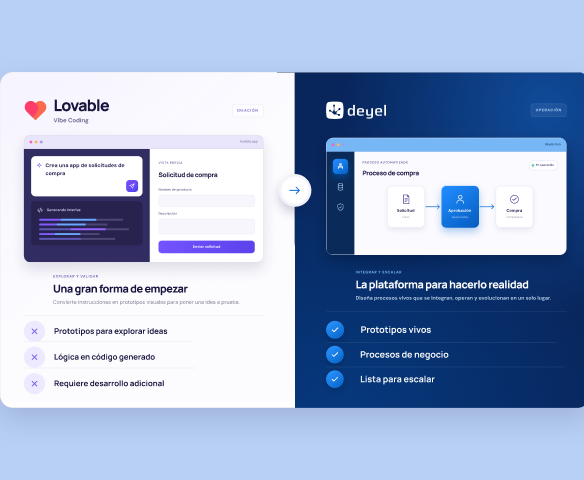
Generating an interactive web application in a matter of minutes from a natural-language instruction has transformed software development.
Tools like Lovable have shown that, for exploring ideas, validating hypotheses, or designing initial prototypes, vibe coding more than delivers on its promise of agility.
However, creating a functional interface is only the first step.
When a proof of concept becomes a real business process, the technical conversation changes. And in the enterprise context, generating prototypes at lightning speed is not enough. Organizations need assurance that those applications can run in production without creating technical debt.
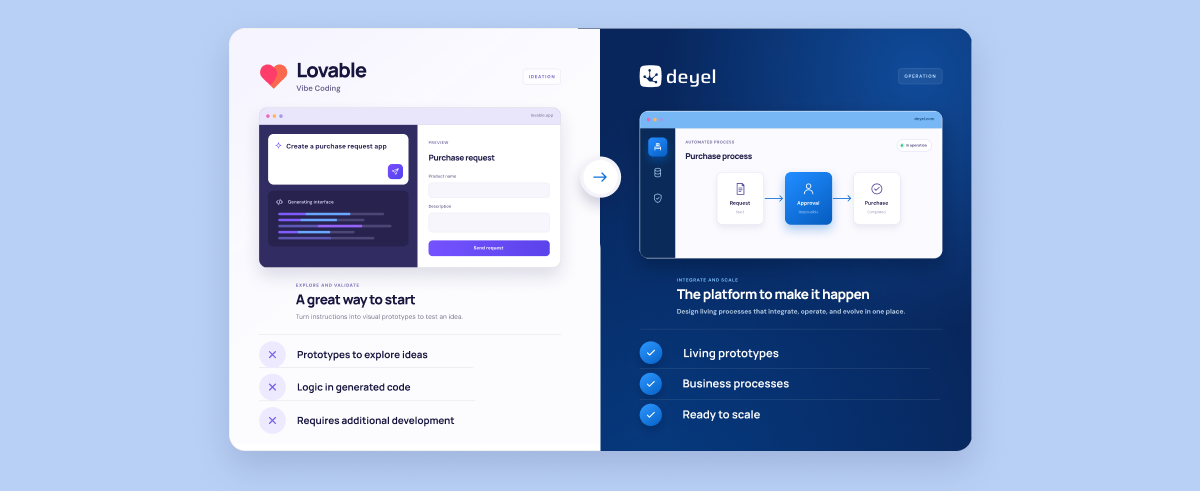
From Prompt to Production: No Disposable Code
The major challenge with traditional code generators is the gap that emerges between the initial prototype and the standards IT requires for production environments. As an application matures and incorporates more complex rules, continuous modification through synthetic code (TypeScript or React) makes auditing more difficult, introduces regression risks, and creates significant technical debt. This often forces developers to discard the prototype and rebuild the solution on a traditional architecture.
Deyel turns initial exploration into a productive asset:
- Live Prototypes in Sandbox: The visual model built from the initial discovery stage runs in a governed environment (Sandbox); it is not a static or isolated mockup, but the actual functional foundation of the application.
- Continuous Path (Business + IT): Business teams model the first AI-powered prototype in a shared environment. Then, through a transparent review workflow, IT takes the same project to connect the enterprise core, apply security, and extend backend rules, without discarding previous work or rebuilding everything from scratch.
- Visual Maintainability and Evolvability: Instead of modifying code files that are prone to regressions, changes are applied to the platform's visual model. The architecture absorbs the complexity, ensuring that the application can grow without breaking dependencies or accumulating technical debt.
Governed AI: The Human-in-the-Loop Approach
AI-driven acceleration requires technical precision, transparency, and architectural control. Delivering synthetic code in a "black box" without structural oversight increases the risk of technical debt, security failures, and behaviors that are difficult to audit in enterprise environments.
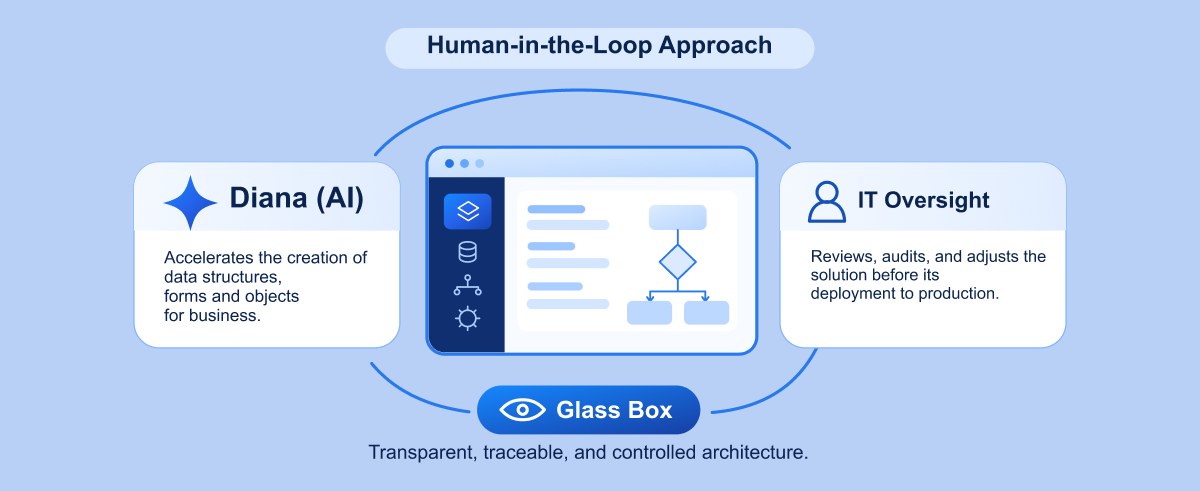
At Deyel, AI operates under a Human-in-the-Loop model within a transparent architecture (Glass Box):
- Development Guided by Diana: Our Artificial Intelligence Agent integrated into the development lifecycle (DIANA) interprets what you need and translates it into visual components within Deyel: forms, workflows, business rules, pages, and entities. It builds directly on the platform, ensuring scalability and security from the very first prompt.
- Native Governance and Secure Co-Creation: Unlike generators that deliver isolated code files that IT must patch afterward, Deyel establishes shared responsibility from day one. Business teams prototype with agility, while IT validates within the same platform under strict enterprise security frameworks.
Software "Day 2": Long-Term Maintenance and Evolution
The true cost of software does not lie in the initial build phase, but in its ongoing operation. When an application has been running in production for six months and regulatory changes, external audits, or new integrations emerge, the maintenance strategy determines the project's long-term viability.
- The Challenge with Prompt-Generated Code: Modifying a mature application through prompts can introduce unexpected side effects (regressions), break library dependencies, or overwrite security configurations that a developer previously implemented manually.
- Stability with Deyel: Because the logic resides in a parameterized visual model, adjusting a business rule or adding an approval step does not alter the integrity of the underlying code. Changes are tested, audited, and deployed in a controlled manner without the degradation risk that synthetic code can face at scale.
Governance and Integration with Core Systems
Bringing an application into the enterprise environment requires addressing persistence, connectivity, and long-term Total Cost of Ownership (TCO).
- Native Integration with Legacy Systems: Instead of operating with simulated data or data trapped in isolated databases, Deyel connects directly to production systems (SAP, Oracle, SQL Server) and complex APIs.
- Governance from Day One: It ensures traceability (Audit Trail), granular role-based access control (RBAC), and integration with enterprise SSO without the need to patch security afterward.
- Predictable Costs and Operations: By integrating the interface, business rules, workflows, and database into a single platform, organizations eliminate fragmented licenses, scattered cloud tools, and the hidden costs of maintaining third-party integrations.
Business Agility with IT Rigor
Vibe coding tools represent a significant advance for visual exploration and agile prototyping. However, when an organization needs to transform operational processes, integrate legacy systems, and ensure scalability under IT standards, model-driven development provides the right architectural foundation.
Deyel combines the acceleration of Artificial Intelligence with the robustness of an enterprise platform, enabling Business and IT teams to build software along the same continuous path, with speed and without technical debt.
Prototypes vs. Applications: Why Deyel Goes Beyond Standalone AI Generators
| Code Generators and Standalone AI Builders | Deyel Enterprise Platform |
|---|---|
|
Disposable, Disconnected Prototypes
Static mockups or raw code files that communicate an idea but must be discarded and rebuilt from scratch by IT before reaching production. |
Live, Production-Ready Prototypes
The visual model built by Business is the actual application. IT extends the data and backend logic directly without rewriting code. |
|
Fragmented, Non-Auditable Code
Standalone AI tools that generate ungoverned code files that IT cannot properly audit, maintain, or secure under enterprise standards. |
Architecture for the Full SDLC and AI (DIANA)
Native visual modeling and integrated AI agents that build governed, scalable components aligned with enterprise security standards. |
Want to Take Your Prototypes to Production Without Technical Risk?
Discover how Deyel enables your team to accelerate innovation while ensuring governance, integration, and maintainability from day one.
