



End-to-End Supplier Management: Risk and the Procure-to-Pay Cycle
November 6, 2026
Lovable vs. Deyel: From Vibe Coding to Enterprise Applications
November 6, 2026Compras y proveedores a prueba de futuro: Customizar y extender sin riesgos
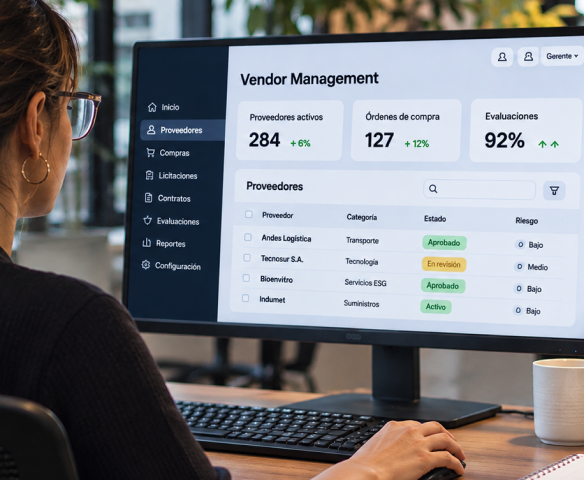
One of the greatest challenges when digitizing Procurement arises when the chosen solution encounters the company's operational reality. No procurement process is identical to another: each organization manages specific tax structures, complex authorization matrices, and an ecosystem of legacy systems that must coexist.
To address this complexity without falling into rigid structures, leading solutions combine two fundamental capabilities: Customization and Extensibility. Far from being mutually exclusive options, they work as complementary forces: the first adapts the system's internal behavior, while the second expands its boundaries to connect new capabilities.
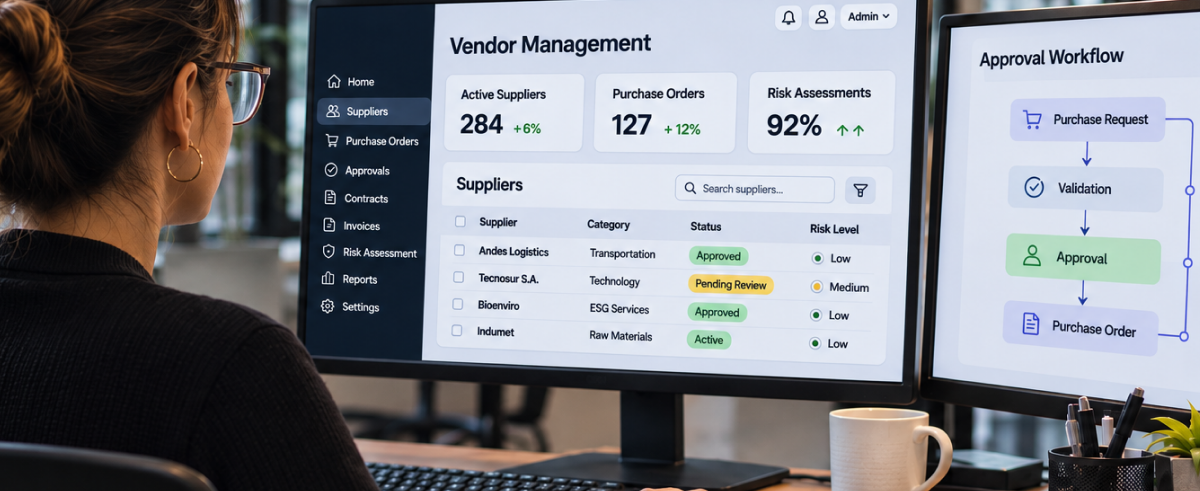
1. Customization: Shaping Internal Logic Around Business Processes
Customization refers to the ability to adapt the solution to meet the company's specific requirements:
-
Data Structure and Forms: Incorporation of specific attributes into Requests for Quotation (RFQ), purchase orders, or supplier records, such as local environmental licenses or tax registrations for each jurisdiction.
-
Dynamic Approval Workflows: Configuration of workflows that escalate purchase authorization according to amount, input category, business unit, or supplier risk level.
-
Rule Governance and Compliance: Configuration of automated controls through the business rules engine, such as preventive blocks when insurance policies expire or alerts for deviations from service level agreements (SLAs).
-
Adapted Portals: Customization of the supplier self-service interface in alignment with the company's visual and institutional identity.
The advantage of an adaptable solution: Controlling customization and extensibility means that technology adapts to your company's pace and identity, not the other way around. This flexibility makes it possible to implement regulatory changes in days, incorporate advanced tools as the function matures, and scale operations without friction or hidden reimplementation costs.
2. Extensibility: Connecting and Building New Capabilities Without Altering the Core
Extensibility is the software's ability to connect external services or build additional functionality without modifying the core code of the main system. This architecture ensures that the solution can receive continuous updates without putting configurations or operational stability at risk.
Key extensibility mechanisms in the procurement environment include:
-
API Integration (REST / OpenAPI / Swagger): Bidirectional connectivity between the procurement module and the corporate ERP (SAP, Oracle, NetSuite) through connectors and standard specifications to synchronize budgets, invoices, and supplier master data in real time.
-
Data Enrichment Services: Automatic connection to external audit sources, such as credit risk agencies, SAT/SUNAT tax validations, or sanctions lists, to validate a third party's financial and reputational health during onboarding.
-
Event-Driven Orchestration and Scheduled Tasks: Triggering integration rules and automated actions across external applications; for example, notifying the accounting or access management system when a supplier moves to "Approved" status.
-
AI Agents as Native Objects: Incorporation of specialized cognitive capabilities—such as agents for automated invoice reading or risk assessment—integrated as native objects within the application model and governed by a central security policy and execution engine.
The Perfect Synergy
| Dimension | Customization (Adapts Internally) | Extensibility (Expands Outward) |
|---|---|---|
| Approach | Modify and configure process logic and rules according to business needs without relying on complex development. | Connect the system to external services or build new capabilities on standard interfaces. |
| Maintenance | Agile and secure, managed through visual configurations, business rules, and parameters without altering the source code. | Continuous and protected, supported by connectors, REST APIs, and OpenAPI / Swagger specifications that do not compromise updates. |
| Use Case | Configure an Approval Matrix so that purchases above USD 10,000 require the CFO's approval. | Automatically synchronize Purchase Orders with the ERP (SAP/NetSuite) or validate tax records in real time via API. |
What Does a Company Lose with a Closed Solution?
Relying on rigid tools that do not allow organizations to adapt their rules or extend their integrations has a direct impact on business performance:
-
Agility: Months of waiting to modify a simple approval workflow or a supplier onboarding form.
-
Governance: Loss of operational control and traceability when exceptions must be managed outside the system, through emails or parallel spreadsheets.
-
Evolution: Inability to connect new technologies—such as native AI agents or financial scoring services—without having to replace the entire solution.
Business Impact: Agility, Efficiency, and Operational Autonomy
For Procurement and Finance leaders, having technology designed to adapt and extend transforms the operating model in three key areas:
-
Lower Total Cost of Ownership (TCO): It eliminates the traditional software maintenance cycle, where every process change or update requires custom code built from scratch or complex reimplementations.
-
Faster Time-to-Market: When a new tax requirement or an internal change in procurement policies arises, your team can adapt forms, business rules, or approvals in days rather than months.
-
Operational Agility and Shared Governance: Enables parameters, fields, and approval workflows to be adjusted directly by the business area through a clear and manageable approach, ensuring operational traceability while IT maintains centralized oversight and integration security.
Combining agile customization with native extensibility ensures that supplier management responds to current business requirements while maintaining the strategic flexibility needed to evolve at the pace of the market.
Looking to adapt your procurement ecosystem without compromising its technological evolution?
Discover how Deyel Vendor Management combines operational flexibility, AI agents, and native integrations to transform your procurement cycle.
