



The human factor in the era of Multi-Agent AI: supervision and strategy
October 29, 2025
Agent vs. Chatbot: The Value of Multi-Agent AI in Low-Code Platforms
November 28, 2025Multi-Agent AI and Low Code in business transformation
The term "AI" can evoke both promises of productivity and the complexity of implementation. In the corporate environment, this complexity often translates into costly pilot projects that fail to scale into the core business operation. However, the key growth differentiator lies in adopting a new approach: Multi-Agent AI, a technical framework that simulates the behavior of a human team of experts and, when combined with Low Code development, transforms how sectors such as Banking and Insurance build their enterprise applications.

What is Multi-Agent AI and how does it transform processes?
Think about your most complex business challenge — it’s not solved by a single person but by a multidisciplinary team. Multi-Agent AI replicates this dynamic.
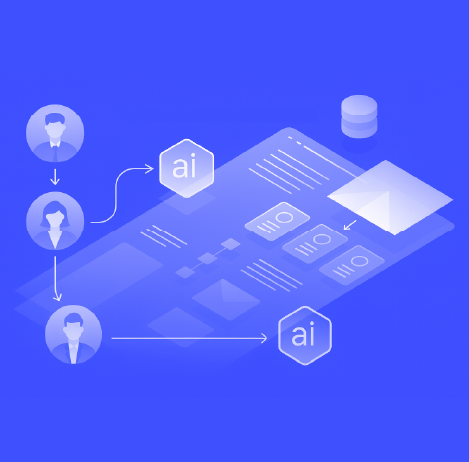
A multi-agent system is made up of multiple autonomous AI Agents, each specialized in a specific task or domain of knowledge (for example, document analysis, fraud detection, route optimization). These agents interact and collaborate with each other to achieve a shared goal — one that is broader and more complex than any single model could handle.
How this “Team of Agents” works:
- Specialization: One agent focuses on the user interface (Page Agent), another on business logic and data (Entity Agent), and a third on automated decision-making (Rules Agent).
- Collaboration: When a complex request is initiated (such as originating a new credit application), the agents interact: the Page Agent guides the user through the form, the Entity Agent stores and manages financial and document information, and the Rules Agent automatically evaluates whether the applicant meets risk and compliance criteria.
- Cohesive outcome: The system delivers a pre-approval or rejection decision based on the configured business logic — all in record time.
Thus, AI Agents function as individual components that, through interaction, contribute to achieving broader goals. This approach mirrors how human teams operate, ensuring that AI can understand intent and deliver precise, fact-based responses.
The strategic fusion: Low Code and Multi-Agent AI
The main obstacle for AI in enterprise environments has always been the speed of implementation and the integration cost with legacy systems. This is where Low Code (application development with minimal coding) becomes the value accelerator for Multi-Agent AI.
The Low Code approach provides an agile framework that allows business teams or developers with less technical experience to:
- Design the “playing field”: Create interfaces, workflows, and business rules that orchestrate interactions between AI agents and existing systems (ERPs, CRMs, core banking).
- Enable rapid integration: Connect specialized AI agents to the organization’s dispersed data sources (PDFs, Excel, databases) without months-long integration projects.
This combination allows companies to materialize exponential value generated through collaboration between humans and Artificial Intelligence — at the speed business demands.
AI as part of business strategy: What role does an operations leader play?
Multi-Agent AI invites us to shift our leadership mindset, understanding that the role of an operations leader remains fundamental — though it has evolved. In the past, the focus was on operational risk management and manual process validation. Now, we must:
- Define the mission of the agents: Clarify the business goal that each AI “team” must achieve.
- Ensure governance: Since 68% of companies consider secure data management an obstacle to adopting AI agents, ensuring that Low Code provides the necessary compliance controls becomes our top priority.
- Promote AI literacy: If we apply intelligent tools without fully understanding how they work, we risk creating blind dependency. It’s our responsibility to train teams so they can question and validate results.
Multi-Agent AI, orchestrated with Low Code, enables operations to move from simple task automation to the execution of complex, collaborative, and regulated decisions, freeing teams to focus on strategy and talent management.
The question then is: Is your team ready to stop solving problems sequentially and start tackling them intelligently and collaboratively?
