

Agent Modeling


Enterprise AI agents are intelligent capabilities that are a native part of applications developed with Deyel.
The agent modeler allows you to define specialized agents that can interpret information, use knowledge, understand the application context, interact with users, and use tools to actively participate in business operations.
An agent is part of the application model and works with the same data, processes, rules, integrations, and security mechanisms already defined in Deyel. It is neither a standalone application nor an external layer. This allows artificial intelligence to be incorporated without duplicating business logic in prompts or building a parallel architecture.
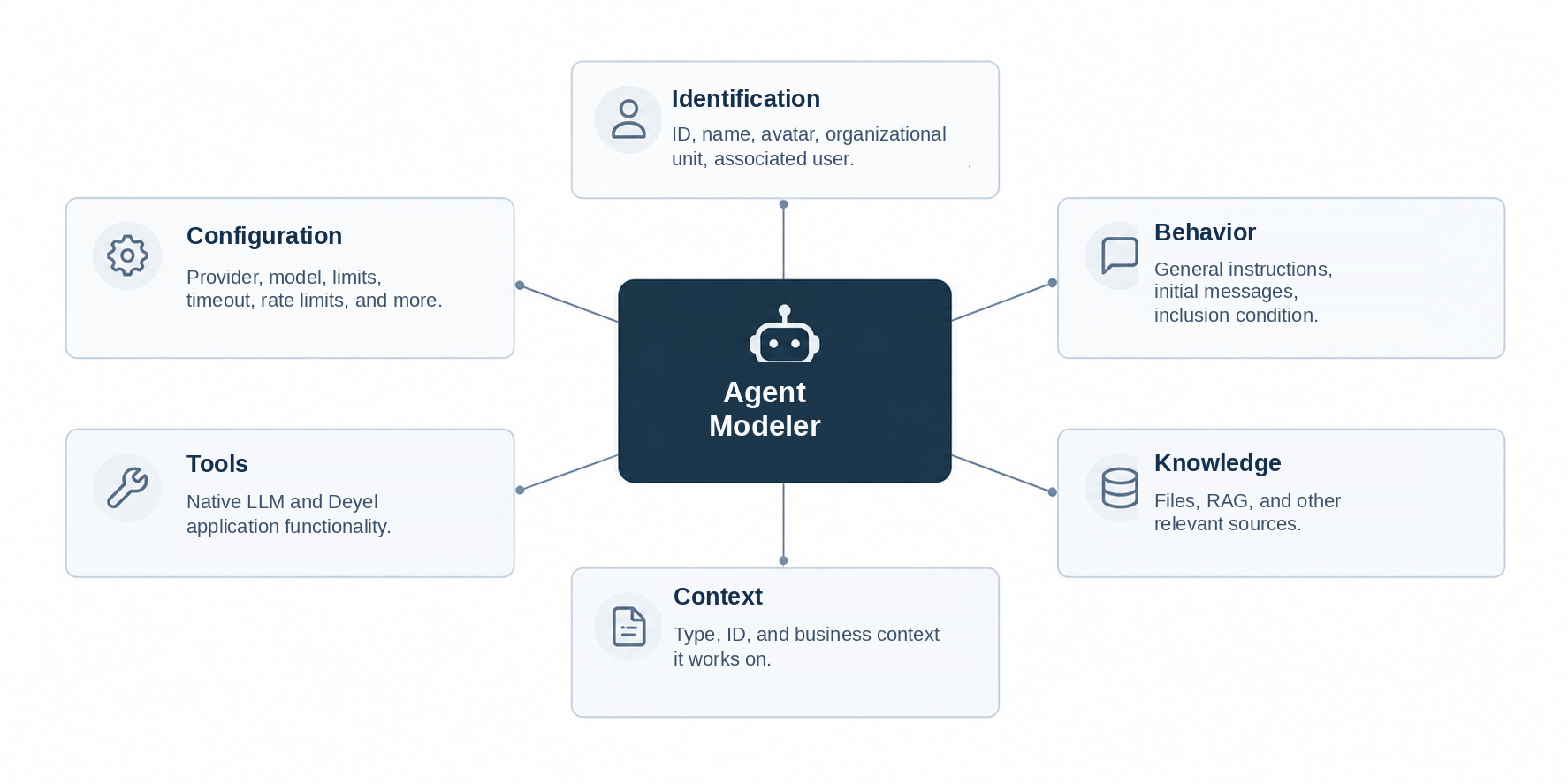
Each agent is modeled declaratively by defining aspects such as:
•Identity: Defines the agent's name, role, and purpose within the application.
•Behavior: Directives and cognitive rules that structure and guide its reasoning.
•Knowledge: Documents and specific information available for the agent to consult.
•Context: Data from the applications involved that the agent can use during execution to retrieve information and perform actions.
•Tools: Application functionalities and capabilities native to Deyel and the language model that the agent can invoke.
•Configuration: Selection of the AI provider and language model, along with the properties and technical parameters associated with its execution.
Agents share the lifecycle of the other objects in Deyel and can be versioned, published, and promoted across environments as part of the application.
Agent execution is coordinated by the AI Runtime, which connects the agent to AI models and the application's capabilities. During each execution, the AI Runtime builds the context, retrieves the required knowledge, checks permissions, applies governance policies, manages the conversation, controls the tools used, and records the information required for auditing and observability.
Agent operation is also subject to the application's AI Governance Policy, which establishes the authorized providers and models, data handling, available tools, operational limits, and audit conditions.
With this model, Deyel applications can evolve into agentic applications, where intelligent agents are part of the architecture and collaborate with users, processes, and other applications and platforms, using a shared business, security, and governance model.
The general characteristics of the agent modeler and its components are described in the following topics:
Agentic Applications
An agentic application is an application in which AI agents are a native part of its architecture and actively participate in business operations.
Unlike an application that simply consumes AI services or incorporates a chatbot, an agentic application integrates agents that can interpret context, use knowledge, invoke tools, and collaborate with users, processes, and other applications and platforms.
In Deyel, agents do not replace existing business logic. They work with the same application data, rules, processes, integrations, and permissions, incorporating cognitive capabilities without creating a parallel architecture.
In this way, applications evolve from a model based solely on users and systems to one in which people, processes, and intelligent agents collaborate within a shared business, security, and governance environment.