


Agent vs. Chatbot: The Value of Multi-Agent AI in Low-Code Platforms
November 28, 2025
Insurance Core: Modernization with Low Code and Multi-Agent AI
November 28, 2025Rapid Enterprise Application Development: Low Code + Multi-Agent AI
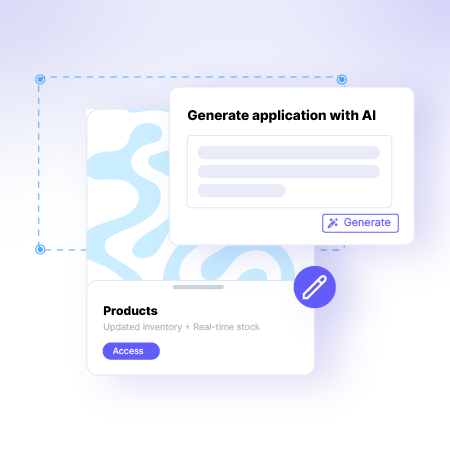
Low Code has become a fundamental pillar of modern software engineering, marking a milestone of democratization and agility by radically simplifying the creation of solutions. This methodology has already transformed the development lifecycle. However, the fusion with Multi-Agent Artificial Intelligence has exponentially amplified its value. Where once there was an agile tool, there now emerges an intelligent, synergistic development ecosystem.
In a scenario where Business demands speed to capture value, and Technology ensures robustness and scalability, multi-agent AI emerges as the necessary force to build applications in a short time.

This convergence not only accelerates implementation but also restructures collaboration, enabling Business to prototype its vision, allowing AI to actively assist IT, and ensuring that final control always remains in human expertise.
1. Solution Prototyping: Business defines, IT implements
Traditionally, the development cycle began with an extensive requirements document. Today, the concept of solution prototyping is gaining significant momentum thanks to Low-Code platforms enhanced with Multi-Agent Artificial Intelligence.
For Business: The Business team is the creator of the need, the logic, and the desired outcome. Using Low-Code environments, they can quickly prototype workflows, business rules, and even the minimum viable interface. This is not just a mockup; it is a functional, living representation of the solution. For the first time, Business delivers a clear and executable business intention, reducing ambiguity.
For IT: Instead of deciphering vague requirements, IT receives a functional prototype with the business logic already defined. Its role shifts to being the strategic architect and final validator of the solution. IT is responsible for:
- Integrating the solution with the company’s core systems and ensuring the underlying complex architecture.
- Ensuring security, scalability, and performance at production level.
- Transforming the proof of concept into a robust, maintainable enterprise solution.
This model drastically reduces feedback cycles and allows IT to focus on quality and structure rather than implementing basic logic.
2. DIANA: Another Developer on the Platform
The team of Artificial Intelligence agents on the Deyel platform is designed to accelerate and simplify the development of enterprise applications. Low-Code platforms allow organizations not only to implement models but also to accelerate the lifecycle of more complex solutions.
In this context, the DIANA Multi-Agent AI integrates as another developer on the team, operating through a conversational natural language approach with prompts.
DIANA’s impact on collaboration:
- For Business: Intentional prototyping. The Business team can describe its specific needs (e.g., “a new subscription flow with data validation”), and DIANA transforms those prompts into the skeleton of a robust and scalable solution. This improves communication and bridges the understanding gap by moving directly from idea to structure.
- For IT: Acceleration and strategic focus. DIANA accelerates coding by generating application components, interfaces, business logic, and complete data entities. This liberating capability allows senior developers to set aside repetitive tasks and focus on solution strategy (what to build), prioritizing security, performance, and complex integrations with the company’s Core.
DIANA’s ability to design, connect, and accelerate—moving from idea to a robust application in a matter of weeks—is the perfect convergence between Artificial Intelligence applied to development and the inherent agility of Low Code.
3. The Autonomy Paradox: AI builds, people execute
One of the most persistent myths is that multi-agent AI will take full control of development. The reality—at least in the mature enterprise ecosystem—is that autonomy must be accompanied by human control.
AI develops, suggests, and generates code; people (IT) validate, approve, and deploy it. This is the central point of collaboration and security:
| Role | Action | Responsibility |
|---|---|---|
| AI Agent | Proposes a new workflow or generates a code snippet for a functionality. | Optimization, Efficiency, Speed. |
| Person (IT Developer) | Reviews, validates, modifies, and deploys the implementation into the production environment. | Security, Compliance, Architecture, Sustainability. |
The IT team maintains full control over deployment, ensuring that every solution—whether accelerated by AI or prototyped by Business users—meets the company’s rigorous standards. This layer of human validation is what provides the necessary trust in critical systems.
The future of development is collaborative
Multi-Agent AI and Low Code are not tools meant to make IT disappear, but catalysts for its evolution. By enabling Business to express its vision in an executable form, and by empowering IT with an “assistant developer” like DIANA, organizations are achieving agile, secure, and aligned development that supports their growth objectives.
